
When luxury means time, calm and meaning
There is a moment when couples realise that a wedding does not need to be louder, bigger, or faster to be extraordinary.
It needs to be intentional.
At Dybiec Wedding, luxury is never defined by excess. It is defined by time. By calm. By the feeling that nothing is rushed and nothing is accidental.
That is why Magdalena designs weddings in Mallorca as carefully curated 3-day celebrations—where every chapter has space to breathe and every emotion has room to unfold naturally.
Why a wedding should not be rushed into one day

One day is rarely enough to truly experience what matters most.
When everything is compressed into a few hours, couples often find themselves moving from one moment to another without presence. Guests arrive, celebrate, and leave before real connections have time to form. The ceremony becomes beautiful but fleeting.
A 3-day wedding celebration changes the entire rhythm.
It allows arrival without urgency.
It allows celebration without pressure.
It allows farewell without sadness.
Magdalena approaches weddings as experiences rather than schedules. Each day has its own intention, its own atmosphere, and its own emotional weight.
The problem with single-day weddings
Consider the typical single-day destination wedding:
Morning: Guests wake up in unfamiliar surroundings, often tired from travel the day before.
Afternoon: Rush to get ready, navigate to the venue, find parking, locate seats—all while trying to look relaxed and happy.
Evening: Ceremony (30 minutes), cocktail hour (rushed because timeline is tight), dinner (interrupted by speeches and formalities), dancing (cut short because venue has curfew), and suddenly—goodnight.
Next day: Checkout, airport, home. The wedding is over before it truly began.
What gets lost:
- Real conversations with people you rarely see
- Time to absorb the beauty of where you are
- Calm moments between the couple and their parents, siblings, closest friends
- The feeling that you were truly present, not just performing
A 3-day wedding experience solves this—not by adding more events, but by creating space for what actually matters.
Day one: arrival and gentle beginning

The first day is not about spectacle. It is about grounding.
Guests arrive from different parts of the world and are welcomed slowly—often with a relaxed gathering, a shared meal, or a sunset moment overlooking the island’s landscape. There is no formal programme and no expectations to perform.
What day one typically looks like
Afternoon/early evening: arrival
Guests check into their accommodation at their own pace. There’s no rushed timeline. No panic about being late.
Some arrive early and explore the area. Others rest after travel. The day feels spacious.
Evening: welcome gathering
This is not a “pre-wedding event.” It is the beginning of the wedding experience.
Typical formats include:
- Informal welcome dinner at a local restaurant or the wedding venue
- Sunset drinks at a scenic viewpoint or beach club
- Casual gathering at a finca or villa with light food and conversation
The atmosphere is intentionally relaxed. No speeches. No schedule. Just reconnection.
Why this day matters
For guests:
By the time they go to bed, they’ve already transitioned mentally from “I just travelled here” to “I’m part of this celebration.” Jet lag is acknowledged. Travel stress dissolves. Strangers become familiar faces.
For the couple:
Instead of spending your wedding day greeting people you haven’t seen in years while trying to remember their names, you’ve already hugged them, caught up, and settled into their presence.
The next day, you’ll walk down the aisle surrounded by people who already feel present—not just physically there.
For families:
Day One allows families from different sides (or different countries) to meet, mingle, and find common ground before the ceremony. This transforms the wedding day itself—what could feel formal becomes genuinely warm.
“The welcome dinner was the moment we realised this wedding was going to be different. Everyone relaxed. My dad started telling stories. My best friend met my husband’s best friend and they’ve been mates ever since. By the time we went to bed, we felt like the wedding had already begun—in the best possible way.”
Day two: ceremony and celebration
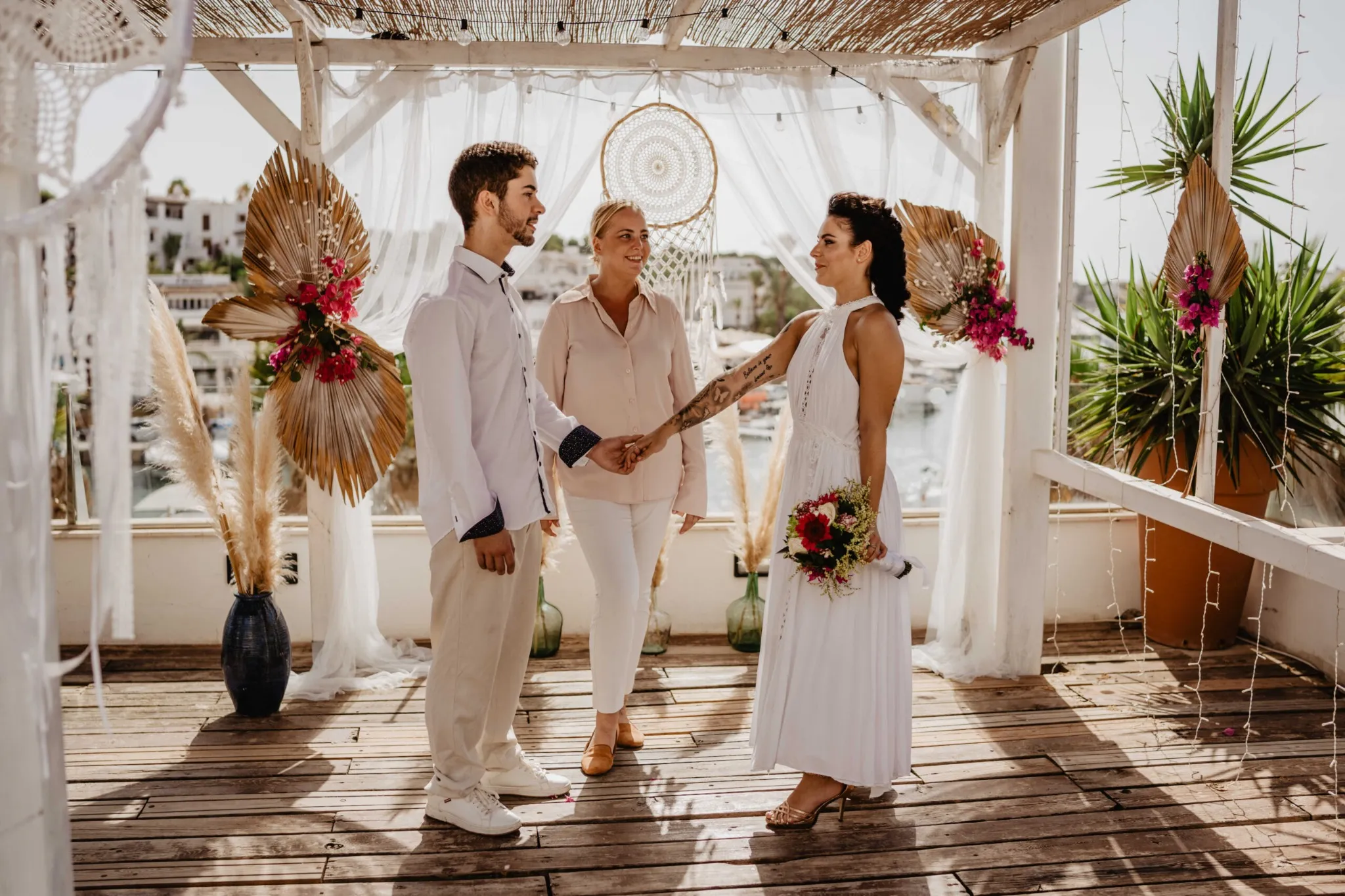
The second day is the heart of the experience.
But because of everything that came before, it doesn’t carry the weight of being “the only day that matters.” It feels like the natural culmination of a story that’s already unfolding.
The ceremony
The ceremony is not treated as a standalone event, but as the emotional centre of a larger experience.
Because guests are already connected and relaxed, the atmosphere becomes intimate and genuine. People cry real tears. Laughter is spontaneous. The moment feels lived, not performed.
Magdalena is known for ceremonies that feel:
- Personal – Reflecting the couple’s actual story, not generic wedding language
- Grounded – Rooted in meaning, not spectacle
- Quietly powerful – Nothing is overstated. Nothing is theatrical for the sake of effect.
Every word, every pause, and every gesture has meaning.
Whether it’s a Catholic ceremony in a Mallorcan church, a civil ceremony in a garden, or a symbolic celebration under olive trees—the focus remains the same: presence over performance.
The celebration
The celebration that follows is elegant, unhurried, and designed around flow rather than intensity.
Music, light, and space work together to support connection rather than overwhelm it.
What this looks like in practice:
Cocktail hour is genuinely relaxed—not a rushed interlude between ceremony and dinner. Guests have time to take photos, explore the venue, have real conversations.
Dinner is paced to allow for both nourishment and conversation. Courses arrive with intention. Speeches are timed so they enhance the evening rather than interrupt it.
Dancing happens organically. There’s no forced “everyone on the dance floor NOW” energy. Music builds naturally. Some guests dance all night. Others talk quietly on terraces under the stars. Both are perfect.
The couple moves through the evening without feeling like they’re hosting a performance. They eat. They talk. They laugh. They dance. They feel present.
Why day two works better in a 3-day format
Because it’s not carrying the weight of being “everything,” it can breathe.
The pressure to squeeze every moment—first dance, cake cutting, bouquet toss, speeches, parent dances, sparkler exit—into one timeline dissolves.
What matters stays. What doesn’t serve the couple falls away naturally.
And because guests aren’t exhausted from just arriving or anxious about leaving the next morning, they’re fully present for the moments that matter.
Day three: farewell without rush

The final day is often underestimated, yet it is one of the most meaningful.
Why day three matters
Most weddings end abruptly.
The final song plays. Sparklers are lit. Photos are taken. Guests scatter to their cars. The couple collapses into bed, emotionally drained. The next morning, everyone checks out, heads to the airport, and it’s over.
There’s no closure. No gentle ending. Just… departure.
A 3-day wedding includes a proper farewell.
What day three typically looks like
Late morning: farewell brunch or gathering
Not everyone attends (and that’s fine), but for those who want to extend the experience, there’s a final shared moment.
Typical formats include:
- Relaxed brunch at the venue, a beach club, or a local restaurant
- Morning by the pool with coffee, pastries, and conversation
- Casual walk or activity (vineyard visit, beach time, market exploration)
The atmosphere:
Unhurried. Reflective. Grateful.
Conversations continue. Photos are shared. Stories from the night before are retold. The couple mingles without the pressure of being “on.”
What this creates
For guests:
Instead of waking up hungover with a 10am checkout and a flight to catch, they have time to exhale. To process. To say proper goodbyes.
International guests especially appreciate this—they’ve travelled far, and the extra day makes the journey feel worthwhile.
For the couple:
Day Three is often the day couples remember most fondly.
The adrenaline has settled. The formal “wedding” pressure is gone. What remains is pure gratitude and connection.
Many couples say that Day three is when the wedding truly sinks in—when they can look around and think, “This actually happened. These people came all this way for us.”
For families:
Parents, grandparents, siblings—people who rarely get extended time together—use Day Three to simply be together. No schedule. No formality. Just presence.
“Day Three was my favourite. We sat by the pool with my parents, my brother, and a few close friends. No agenda. No timeline. Just coffee, laughter, and this overwhelming feeling of gratitude. That’s the day I truly absorbed what had just happened.”
Mallorca as a partner, not a backdrop

Mallorca is never used as a decorative postcard.
Magdalena works with the island respectfully, understanding its rhythm, light, and landscape. Venues are chosen for authenticity rather than scale. Local textures, natural materials, and understated elegance replace theatrical staging.
What this means in practice
Venues are selected because they feel like they belong to Mallorca—not because they look impressive on Instagram.
A restored finca with stone walls and olive trees. A family-run vineyard. A chapel that’s been part of a village for centuries.
Food reflects the island’s seasons and producers. Local wine. Fresh seafood. Heirloom tomatoes. Flor de Sal d’Es Trenc. Almonds and figs.
Florals use what grows naturally in Mallorca, rather than importing hundreds of roses from Holland.
Music might include local musicians who understand the island’s acoustic spaces.
This approach results in weddings that feel rooted rather than imposed.
They belong to the place instead of competing with it.
Learn more about choosing the right wedding venue in Mallorca that supports this philosophy.
Boutique by choice, not by limitation
Dybiec Wedding works intentionally in a boutique model.
Magdalena accepts a limited number of couples each season to remain personally involved in every project. This is not a marketing statement, but a working principle.
Presence, availability, and emotional continuity cannot be scaled without compromise.
What this means for you
You are not passed between systems or teams.
From your first enquiry to your final farewell, Magdalena is your planner. You don’t get handed off to an assistant, a coordinator, or an “on-the-day team.” You work with one person who understands your story from beginning to end.
Your wedding is not built from a template.
Every 3-day celebration is designed specifically for the couple. The welcome dinner format. The ceremony tone. The farewell experience. Nothing is copy-pasted from the previous wedding.
You have access, not just service.
Boutique planning means Magdalena is genuinely available. Questions are answered thoughtfully, not by an automated system. Decisions are discussed, not rushed.
This is why Dybiec Wedding remains intentionally small—because presence matters more than scale.
Discover more about the values behind Dybiec Wedding and what boutique planning truly means.
The practical side: what a 3-day wedding actually involves

A 3-day wedding sounds romantic (and it is), but it’s also highly practical and structured.
Here’s what it typically involves:
Timeline
Day 1 (Welcome)
- Afternoon: Guest arrivals, check-in
- Evening: Welcome dinner or sunset gathering (2-3 hours)
Day 2 (Wedding)
- Afternoon: Ceremony (30-60 minutes depending on type)
- Evening: Cocktails, dinner, celebration (5-7 hours)
Day 3 (Farewell)
- Late morning/midday: Brunch or casual gathering (2-3 hours)
- Afternoon: Guests depart at their own pace
Budget Considerations
A 3-day format typically adds €8,000–€15,000 to your overall wedding budget, covering:
- Welcome event catering and setup
- Additional venue hire (if applicable)
- Farewell brunch or gathering
- Extended coordination and planning
However, many couples find that spreading the celebration across three days actually reduces stress-related costs—fewer rushed decisions, less need for “backup plans,” and more intentional spending.
For a complete budget breakdown, visit our wedding cost guide for Mallorca.
Guest expectations
Will guests feel obligated to attend everything?
No. Each day is designed as an invitation, not an obligation.
Some guests (especially those travelling far or with young children) attend all three days. Others join only for Day 2. Some stay for Day 3 to extend their holiday.
The structure is flexible by design.
What about guests who can’t stay the full time?
That’s completely normal. Magdalena designs the schedule so that Day 2 (the ceremony and celebration) can stand alone if needed—but for those who can stay, Days 1 and 3 add richness to the experience.
Who Is a 3-day wedding for?

A 3-day wedding celebration is not about adding more. It is about removing pressure.
This format is ideal for couples who:
✓ Value depth over display – You want meaningful moments, not Instagram moments
✓ Want guests to feel cared for, not entertained – The focus is connection, not performance
✓ Believe true luxury is the ability to slow down – You’re not rushing through your wedding to get to “the next thing”
✓ Are planning a destination wedding – International guests appreciate extended time that makes travel worthwhile
✓ Want to actually remember their wedding – When the day isn’t crammed, you can be present for it
✓ Prefer intimate or mid-sized celebrations – Works beautifully for 30–100 guests (though larger is possible)
This format may not be for couples who:
✗ Prefer traditional single-day weddings with clear start/end times
✗ Have very limited budgets (though scaled versions are possible)
✗ Have guests who cannot travel for extended periods
✗ Want a quick, efficient celebration without extended timelines
There’s no judgment either way—every couple’s vision is valid. The question is simply: does this approach align with what you truly want?
What couples say about the 3-day experience
“We almost did a one-day wedding because that’s what everyone does. But Magdalena asked us: ‘What do you actually want to feel during your wedding?’ And we realised—we wanted to feel present. Not rushed. The 3-day format gave us that. It was the best decision we made.”
“Our guests still talk about it. Not just the wedding day, but the whole weekend. The welcome dinner where everyone actually got to know each other. The morning after when we all had breakfast by the pool and no one was in a rush to leave. It felt like a real celebration, not just an event.”
“I was worried it would be too much—too expensive, too complicated, too demanding for guests. But it was the opposite. Everything felt easier because nothing was crammed. And our guests told us it was the best wedding they’d ever been to, not because it was fancy, but because it actually felt real.”
How to start planning a 3-day wedding in Mallorca
If this approach resonates with you, the first step is simple: a conversation.
Magdalena will discuss:
- Your vision for the celebration
- Guest count and timeline preferences
- Budget considerations
- Venue options that support multi-day experiences
- How the 3-day format can be tailored to your specific needs
There’s no pressure. No hard sell. Just honest guidance about whether this format aligns with what you truly want.
When to enquire
Ideally 12–18 months in advance.
Due to the boutique nature of Dybiec Wedding and the limited availability of venues that support 3-day celebrations, early planning is essential—especially for peak season (May–October).
Begin your 3-day wedding journey
At Dybiec Wedding, the goal is never to impress. The goal is to create a space where something real can happen.
If you value time over spectacle, connection over performance, and presence over perfection—a 3-day wedding celebration in Mallorca may be exactly what you’re looking for.
Contact Magdalena to begin the conversation about your wedding in Mallorca.
→ Start planning a wedding that feels like you.eExplore our destination wedding planning services and approach.
Frequently Asked Questions
Is a 3-day wedding only for massive guest lists?
Not at all. In fact, the format works best for intimate and medium-sized weddings (30–100 guests). It allows deeper connection regardless of guest count. Smaller weddings often benefit most from the extended timeline.
Do we need to plan activities for all three days?
No. Magdalena designs a framework, not a timetable. Free time and flexibility are essential parts of the experience. Guests aren’t entertained—they’re given space to connect, explore, or simply relax.
Will guests feel obligated to attend everything?
No. Each day is optional in spirit, even if invited. Guests naturally choose their level of participation without pressure. Some attend all three days. Others join only for the wedding day. Both are completely normal and expected.
Is a 3-day celebration more stressful to organise?
Not when designed properly. For couples, it is often less stressful because the experience is spread out and carefully paced. There’s no single day carrying the weight of “everything must be perfect.” The pressure dissolves naturally across the timeline.
How much does a 3-day wedding cost compared to a single-day wedding?
A 3-day format typically adds €8,000–€15,000 to the overall budget (covering welcome dinner, additional venue time, farewell brunch, extended coordination).
However, total wedding budgets are often comparable because the multi-day format allows for more intentional spending and fewer stress-driven decisions.
For detailed budget guidance, visit our wedding cost breakdown.
When should we enquire if we are considering Mallorca?
Ideally 12 to 18 months in advance. Due to the boutique nature of Dybiec Wedding and limited venue availability for multi-day celebrations, early planning is essential—especially for peak season.
Is this approach suitable for international guests?
Yes—especially so. The format is particularly appreciated by international guests, as it removes the feeling of travelling far for only a few hours of celebration. Extended time makes the journey feel worthwhile and allows guests to experience Mallorca, not just the wedding.
Can we do a modified version (2 days instead of 3)?
Absolutely. The 3-day structure is a framework, not a rule. Some couples do 2 days (welcome + wedding, or wedding + farewell). Others extend to 4 days for larger groups. Magdalena tailors the format to your vision and practical realities.
What if some guests can only come for one day?
That’s completely normal and expected. The wedding day (Day 2) is designed to stand alone as a complete celebration. Days 1 and 3 are enhancements for those who can stay longer—not requirements for participation.
For more detailed planning questions, visit our complete FAQ page.
