

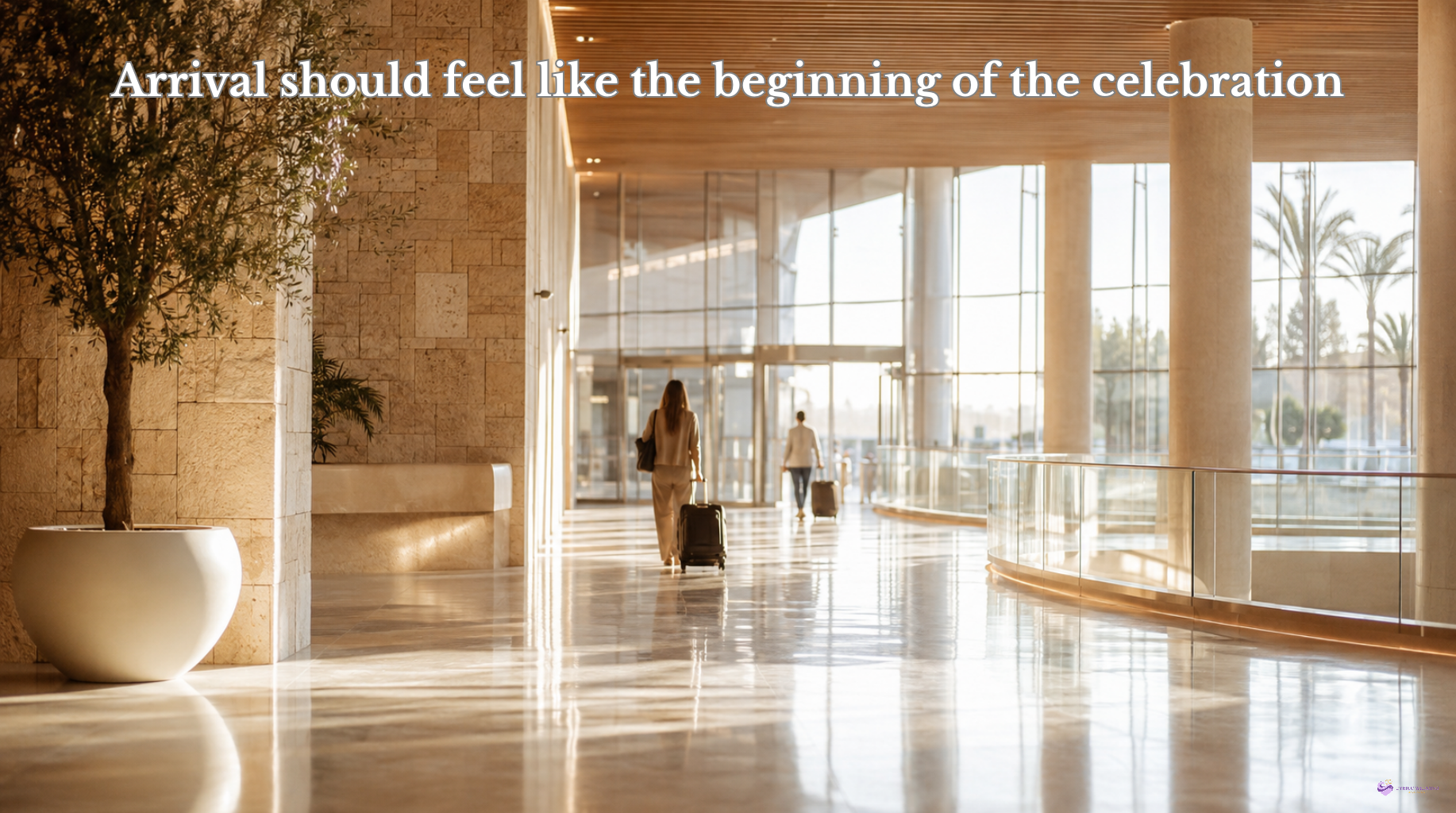
Will your guests actually get there smoothly? For a Mallorca wedding, the answer is decided long before anyone lands in Palma. Mallorca wedding guest logistics work best when passports, flights, airport arrival, accommodation, transfers and the weekend schedule are planned as one journey. When your guests know what to check before they travel, where they are staying and how they reach the venue, you are not answering travel messages on the morning of your ceremony. This guide shows you where to start.
Contents
- Your guests’ journey starts months before the flight
- One source of truth for your guests
- Passports, EES and ETIAS: what UK guests should know
- Arrival at Palma Airport
- Accommodation and transport
- RSVP as a logistics tool
- The whole wedding weekend
- Watch the episode
- Frequently asked questions
- Plan your guests’ journey with Magdalena
Your guests’ journey starts months before the flight
You have probably pictured your ceremony a hundred times. The light, the vows, dinner under the olive trees. Your guests are picturing something else first. The booking. The passport in the drawer. The flight. The moment they walk out into arrivals, looking for a familiar face.
That first part decides how they arrive at your wedding. A guest who has spent two weeks worrying about documents and transfers reaches the welcome drink tired and slightly on edge. A guest who knew what to expect at every step arrives ready to celebrate with you. You will feel the difference too. The first guest sends you messages. The second one sends none.
“Hospitality does not begin at the venue,” says Magdalena, a local wedding planner and celebrant in Mallorca. “It begins the moment someone starts preparing for the journey to get there.”
At one of our weddings, a bridesmaid with a gluten intolerance had her own small cake, ordered alongside the main one. On the night, it never arrived. We found another during the reception, and she had dessert with everyone else. That is what good hospitality looks like from the guest’s side. Your guests’ journey to Mallorca deserves the same care.
One source of truth for your guests
How many places will your guests look for answers? The invitation. The WhatsApp group. An email you sent in March. A message from your mum, passing on what she thinks you said.
Give them one current page instead, with the schedule, the accommodation area, the transport plan, airport information and official travel links. A wedding website or a private guest page works well.
Your closest friend lands from London with three versions of the schedule on her phone. She is not sure which one is current, so she messages you. Now multiply that by sixty guests. The questions arrive while you are getting ready.
A good guest page answers the practical questions before anyone has to ask them:
- Are airport transfers organised, or should guests travel independently?
- Is wedding-day transport provided, and from where?
- What are the return times?
- Who should a guest contact if a flight changes?
Link to official government sources rather than copying entry rules onto the page. Rules can change between the invitation and the wedding. One page, one current version, one place your guests know they can trust. And one less reason for your phone to ring on your wedding morning.
Passports, EES and ETIAS: what UK guests should know
Think about who on your list travels least. Your grandmother. The uncle who last flew abroad years ago. The friend who renewed her passport “not that long ago”. They are the guests most likely to have a passport that looks fine and is not.
Most of your British guests have been to Spain many times, and that is exactly why the entry rules catch them out. Three things are worth explaining early: the passport rule, EES, which is already in place, and ETIAS, which is not yet.
The passport rule
According to GOV.UK travel advice for Spain, a British passport should normally be less than 10 years old on the day of arrival. It should also be valid for at least three months after the planned departure from the Schengen area. Many people still check only the expiry date.
Now imagine your uncle discovering this two weeks before your wedding, with a renewal queue ahead. A small administrative detail suddenly decides whether he sees you get married. One clear reminder in your first travel message, sent months ahead, prevents it. Guests travelling on other passports should check the rules for their own nationality.
EES is already operating
The EU Entry/Exit System has been fully operational at external Schengen borders since 10 April 2026. It records short stays by non-EU travellers, including British guests. A first registration can include a facial image and fingerprints, so it may take more steps than guests remember from earlier trips. The official Travel Europe EES page explains the process.
For you, it means one thing. The moment your guests land and the moment they meet their driver are not the same, and your plans need to know the difference.
ETIAS is not yet in operation
ETIAS is a pre-travel authorisation, which is a different thing from EES. At the time of writing, the official EU portal states that ETIAS is not in operation and that no applications are being collected. The EU has said it will announce a start date several months before launch.
So you do not need to ask anyone to apply now. If your wedding is in 2027, recheck the official ETIAS page before you send final travel information. And if a guest tells you they have already paid for ETIAS online, let them know gently: any website offering ETIAS applications today is not official.
Arrival at Palma Airport
Your parents land in Palma after an early start. They queue at the border, wait for their cases and walk into arrivals looking for a familiar face. Whether someone is standing there decides how their first hour in Mallorca feels, and how many messages you receive that afternoon.
So plan each arrival around the real flight, not around a guessed collection time. Guests from outside the EU pass through border control and collect their luggage before they meet their transfer. Their driver should know the flight number, the agreed meeting point and what happens if the arrival takes longer than expected.
Those few minutes between walking into arrivals and sitting in the car are small, but they set the tone for the whole weekend. Nobody you love should stand in an arrivals hall wondering where to go.
Do not build transfers around an assumed border-processing time. There is no reliable figure, and promising one to your guests creates false confidence. Flight monitoring, sensible buffers and a clear meeting point do the real work. Aena’s guide to the arrivals area describes the general passenger route.
Organised transfers are not always the answer, either. Some guest lists suit individual or grouped transfers. Others do better with independent arrival at one main hotel and organised transport only for the hosted events. The right choice is the one that removes uncertainty for your particular guests.
Accommodation and transport
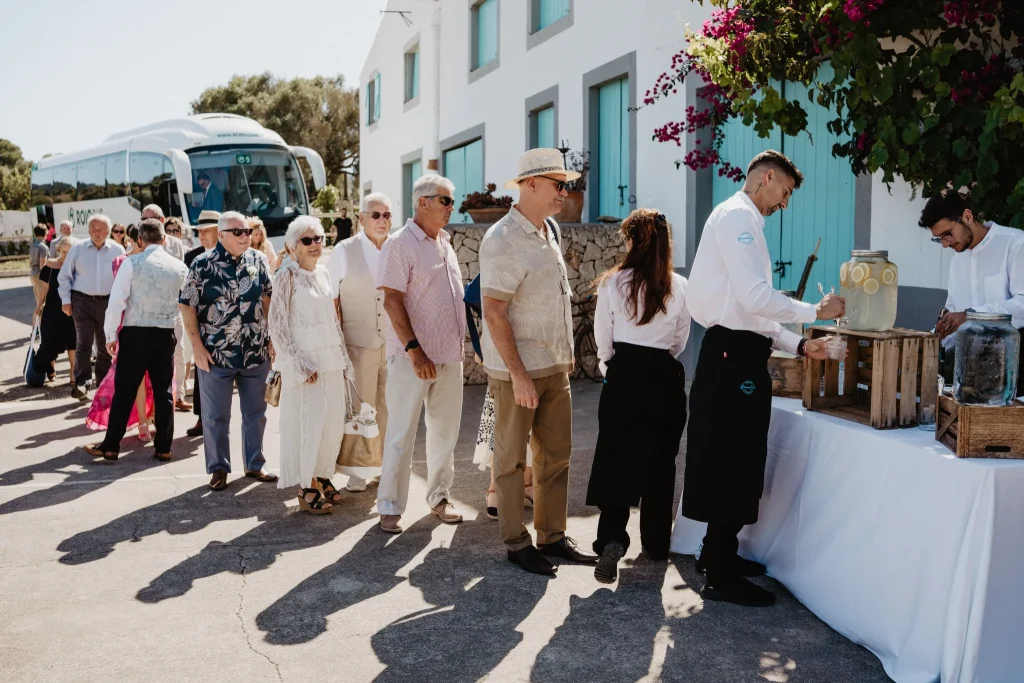
Where your guests sleep decides how they move. If sixty guests stay in one hotel, you have one wedding-day collection point. If the same sixty are spread across Palma, Sóller, private villas and coastal apartments, you have several routes before a single vehicle is booked.

Your godparents have found a lovely villa, forty minutes from everyone else. The coach leaves the main hotel at 3pm. Without a separate plan, they arrive late or by an expensive taxi. That is how a scattered guest base quietly turns into a budget line, and into a worried phone call on your wedding day.
This is why accommodation belongs in your venue conversation, not after it. Our guide to wedding guest accommodation in Mallorca explains the main accommodation models.
Physical access then decides the vehicle. The finca you fell in love with may have an entrance a full-size coach cannot use. Return journeys need the same attention, especially for families with small children and guests with early flights. You will find the operational detail in our guide to wedding transport in Mallorca.
The principle is simple. Choose your guest base, your venue and your transport model together.
RSVP as a logistics tool
Your RSVP can do far more than count chairs. Asked well, it collects what you need to move people through the weekend. It does not need to become a passport database. Ask for what you will actually use, and nothing more.
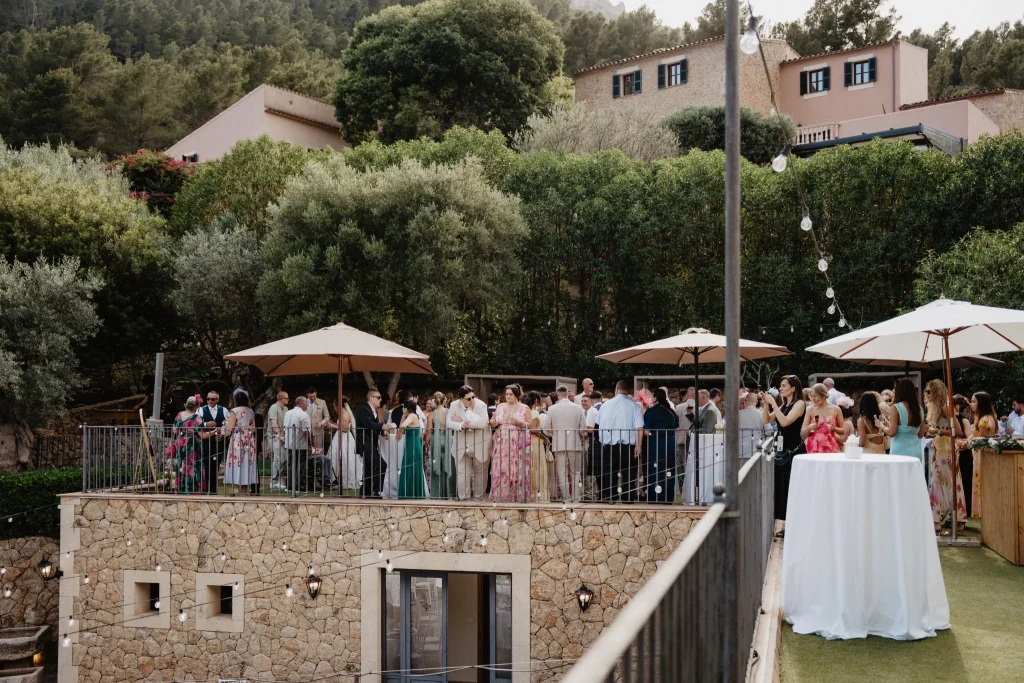
Useful questions to include:
- Attendance at each event.
- Where the guest is staying.
- Whether an airport transfer is needed, with flight details if you are coordinating it.
- Wedding-day transport and the preferred return time.
- Child seats.
- Mobility or accessibility needs.
- Dietary requirements.
Passport numbers do not belong on this list. EES and ETIAS are government systems, and each guest is responsible for meeting their own entry requirements. Collecting passport data gives you sensitive information to protect and nothing useful in return. Share the official links instead, and ask your guests to confirm they have checked the rules for their own passport.
The whole wedding weekend
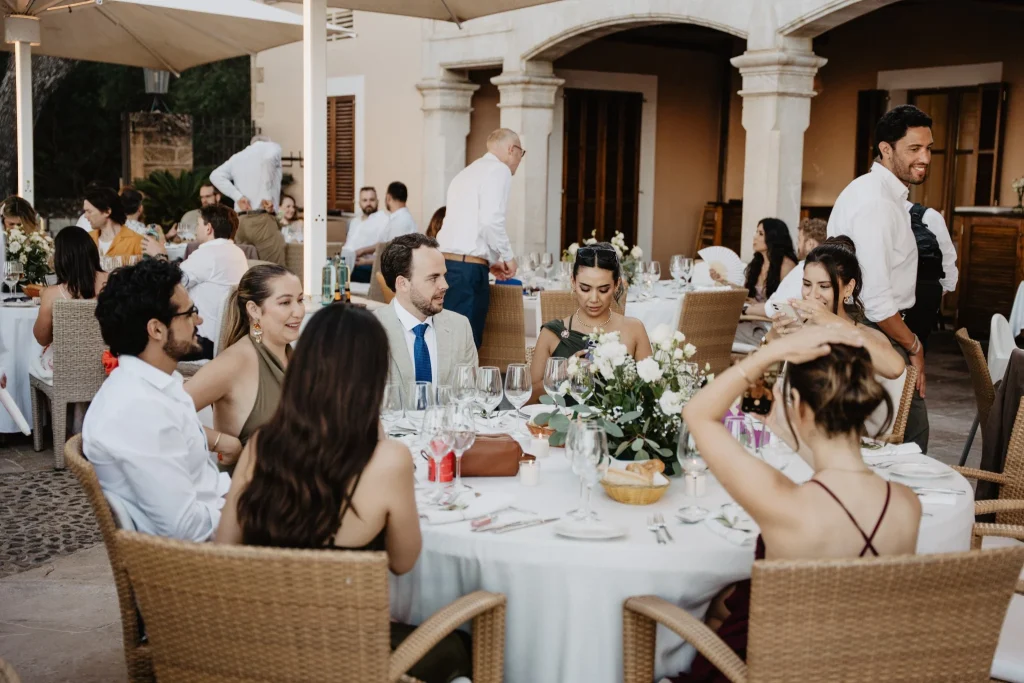
Airport arrival is only the first handover. Over one weekend, your guests may travel from the airport to the hotel, to a welcome drink, to the ceremony, back to the hotel, to a farewell brunch and finally back to the airport. Each stage planned on its own leaves a gap before the next one, and gaps are where questions come from.

At Dybiec Wedding, we organise everything except the flights themselves: accommodation, airport transfers, transport between events and the travel information your guests receive. We look at it as one journey in three connected phases: preparation, arrival and celebration. The aim is not a busier weekend. It is clearer transitions, because every transfer shapes how your wedding is remembered.
Your welcome drink has to fit around when guests actually land. The wedding-day coach plan depends on where everyone slept the night before. Your farewell brunch has to work with check-out, luggage and departing flights.
A multi-day weekend is a different rhythm, not an upgrade. A single wedding day can be organised with exactly the same care. What matters is that the logistics match the format you choose, so that on the day itself, you can simply be there.
Watch the episode
In this episode of The Mallorca Edit, Magdalena answers the question you may already be asking: will our guests actually get there smoothly? She covers:
- why your guests’ experience starts with passports and paperwork, months before anyone flies,
- the passport rule that catches British guests out most often,
- what EES already changes at Palma Airport, and why ETIAS is not needed yet,
- why the minutes between arrivals and the car matter so much,
- how every transfer across the weekend shapes how your wedding is remembered.
“Will our guests actually get there smoothly?”
More episodes are on The Mallorca Edit playlist on YouTube.
Frequently asked questions
Do we need to organise airport transfers for every guest?
No. Transfers make most sense when groups arrive at similar times, the accommodation is hard to reach or your weekend needs tighter coordination. For many weddings, clear guidance for independent arrival plus organised wedding-day transport is enough.
Should we collect our guests’ passport numbers?
Usually not. Collect only the information you need for a confirmed practical purpose. Entry requirements remain each traveller’s responsibility, so link to official sources instead.
Do UK guests need ETIAS to travel to Mallorca now?
No. At the time of writing, ETIAS is not in operation and no applications are being collected. The EU has said it will announce a start date several months before launch. Check the official EU page shortly before you send final travel information.
Will EES make arrivals at Palma Airport slower?
A first biometric registration can take extra steps, so build flexibility into collection plans. No reliable waiting time can be promised. Flight monitoring, realistic buffers and a clear meeting point are the practical answer.
Do guests staying in a private home need an invitation letter?
Sometimes. Spain can ask visitors to show where they will stay. When a guest is hosted by a private individual, a formal Carta de Invitación may apply, and the host requests it from the police where they live. Guests with a hotel or holiday-rental booking usually show that confirmation instead. The Spanish Ministry of the Interior sets out the current procedure.
Plan your guests’ journey with Magdalena
You do not need every answer yet. A venue or a shortlist, a rough guest count and an idea of where your guests are flying from are enough to see whether your Mallorca weekend works in practice.
Share them with Magdalena. She will look at arrival, accommodation and transport as one plan, before individual bookings make it harder to change. From there, we organise everything except the flights, so your guests receive one set of instructions from one team.
Magdalena answers every enquiry herself. You can read how couples describe working with her on the Dybiec Wedding reviews page.
Your guests arrive relaxed. You spend the morning of your wedding getting ready, not answering travel messages.

