


To plan wedding transport in Mallorca, start with where your guests are sleeping. Then check what the venue entrance can physically take, and only then choose vehicles. Give every guest a collection point, a vehicle and a return time before the wedding day. Put one local person in charge of the last departure. This matters most with a rural finca, guests spread across several hotels or a late finish. And on the day, you cannot rescue a guest waiting at the wrong hotel at 4pm. You will be getting ready for your ceremony.
Good transport is the part of the day nobody talks about. Bad transport is the story guests tell on the flight home.
Contents
- Start with a map of where your guests sleep
- If most guests stay in one hotel
- If guests are spread across several hotels
- If your venue is a rural finca
- Choosing vehicles for your Mallorca wedding transport
- Passenger lists and route sheets
- Early returns for families and older guests
- The last departure
- What the transport company needs to know
- Who pays for wedding-day transport?
- Frequently asked questions
- Plan your wedding transport with Magdalena
Start with a map of where your guests sleep
Begin with where people will be when they need collecting, not with the size of the coach. Mark the hotels, villas and apartment areas on one map. Place the venue beside them, then add the ceremony time. This shows whether you need one pick-up, several, or separate routes.
Picture your grandmother in a hotel lobby at 3.45pm, dressed and ready, with no idea which bus is hers. That is the problem a guest map prevents.
Accommodation and transport work together. If you are still deciding where your Mallorca wedding guests should stay, start there. Our guide to wedding guest accommodation in Mallorca explains how one main guest base can simplify the whole weekend. This article starts where those end: you know where people sleep, and now you need to move them.
Avoid promising door-to-door collection from every private apartment. Agreed meeting points are easier to communicate and far easier to control.
If most guests stay in one hotel
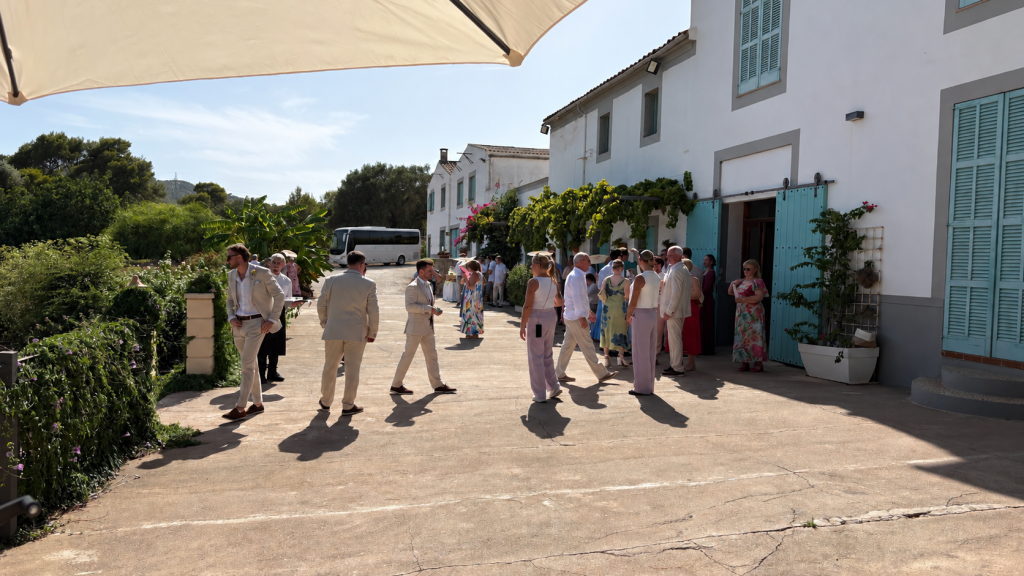
One collection point usually works well. Guests know where to meet. The driver has one departure location. Your planner can see at a glance whether the group is ready.
The detail that matters is the departure time. Do not count back from the ceremony using drive time alone. Allow for guests coming down late, loading the vehicle, the walk from the drop-off point and a sensible buffer.
We like guests to arrive during a welcome period, with a drink in hand, rather than at the minute the ceremony starts. They settle, greet each other and walk into your ceremony relaxed.
One hotel also makes staggered returns simple. An earlier vehicle can take families home without ending the evening for everyone else.
If guests are spread across several hotels
Now transport becomes a routing problem. A single coach calling at every address looks efficient on paper. In practice, each stop is another chance for delay.
Imagine 70 guests across three hotels, plus a few in private apartments. Two neighbouring hotels share one collection point. The third hotel gets its own vehicle. Apartment guests walk or take a short taxi to the nearest point.
Then allocate each guest to a vehicle before the wedding. A message saying “Bus collection at 4pm” is not enough. Guests need to know which collection point, which vehicle and which departure time.
Be realistic about loading time too. Two properties may look close on a map, yet boarding a full coach outside each one can add a surprising amount of time. Clarity is worth more than saving one vehicle with a clever route.
If your venue is a rural finca
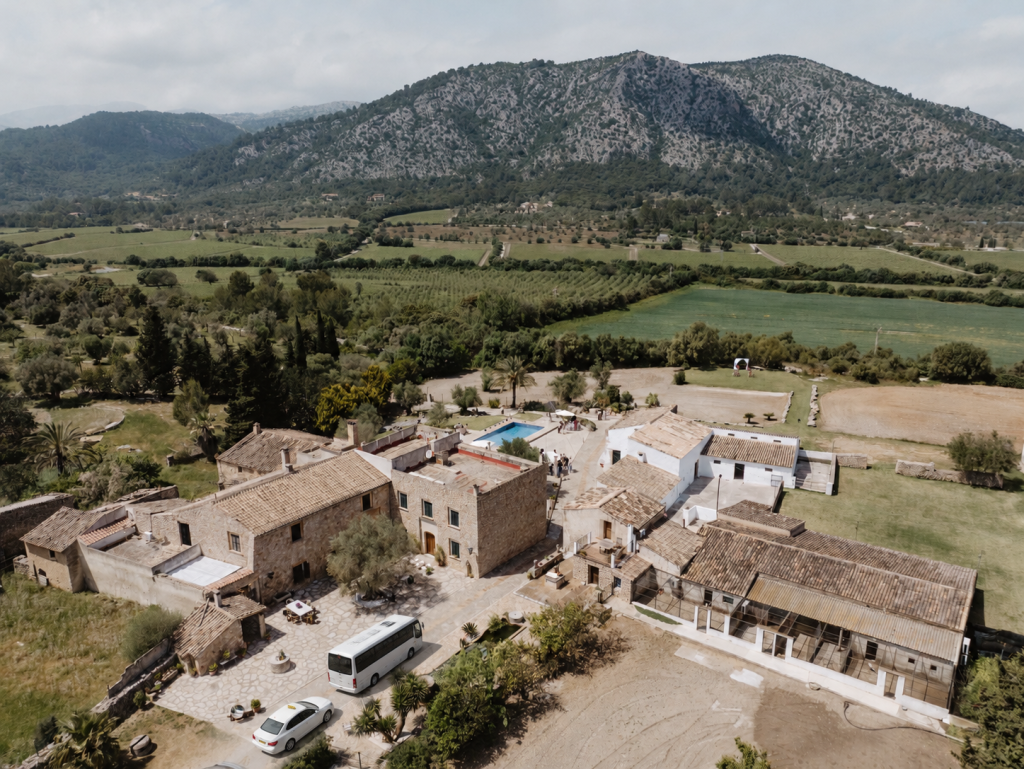
Some of Mallorca’s most beautiful venues are the hardest to reach. A narrow lane, a tight entrance or a small turning area can stop a full-size coach. Never assume a coach can arrive just because cars can.
Settle this before you commit. Ask the venue what the largest vehicle is that can reach the guest drop-off, where it can turn and wait, and whether access changes after dark. Our list of questions to ask before paying a Mallorca wedding venue deposit covers access alongside everything else worth checking.
Sometimes the answer is a minibus, which means several rotations instead of one trip. Your plan then has to include loading and turnaround time, not just road distance.
The problem gets harder at 1am. You do not want 60 guests leaving a finca with poor phone signal and a departure plan that amounts to “find a taxi”.
Already have a finca on your shortlist? Send Magdalena the name before you pay the deposit. She will check what can actually reach the door.
Choosing vehicles for your Mallorca wedding transport
Capacity is only part of the answer. Think about where guests start, what the venue entrance allows, the arrival window and the return plan.
One large coach can suit a group that starts in one place. Two smaller minibuses or shuttles may suit guests spread across different areas, or a finca with restricted access.
Do not plan to fill every seat. Numbers move. Someone hires a car, a relative decides to leave early, a family needs different arrangements for a child. Confirm the final vehicle allocation shortly before the wedding, using the latest guest information.
Passenger lists and route sheets
A good transport plan rests on two documents, and they must agree.
A passenger list answers one question: who is meant to be on this vehicle? It shows each guest or household, their collection point and their planned return.
A route sheet tells the driver what to do. It includes the date, vehicle, driver contact, exact collection points, departure times, the approved drop-off at the venue, and return times with hotel stops.
Consider a driver whose sheet lists Hotel A and Hotel B, while the passenger list puts several Hotel B guests on another bus. Each document looks correct alone. Together they leave people waiting at the kerb.
There should be one master version. Different schedules circulating through WhatsApp, email and old spreadsheets are how mistakes happen. Your planner and the transport company should both know which version is current.
This is not a spreadsheet you should be keeping. If you work with a planner, ask to see both documents before the wedding. They tell you more about the plan than any quote.
Early returns for families and older guests
Not everyone wants the same journey home. Parents of young children may want to leave soon after dinner. Older relatives may love the ceremony and speeches but not want to stay until the music stops.
Two departures often work better than one. An earlier return can follow the main formal moments, and a final return can leave when the celebration ends. Base the times on your wedding timeline, so they do not clash with speeches or the first dance.
Check mobility as well. A guest who manages the day well may still find a long walk from the coach stop difficult after midnight. Look at the real distance from vehicle to hotel entrance, and from drop-off to the celebration area.
Tell the transport provider early if children will travel. Child restraint rules differ between cars, minibuses and coaches. Spain’s traffic authority explains the rules for cars in its DGT guidance on travelling with children. Ask your licensed provider what applies to each vehicle you book. A child seat request on the wedding morning is much harder to solve than the same question weeks earlier.
The last departure
The final vehicle deserves as much planning as the first. By the end of the night, people are tired. Some have enjoyed the bar, and phones may be flat or out of signal. That is not the moment to decide who goes where.
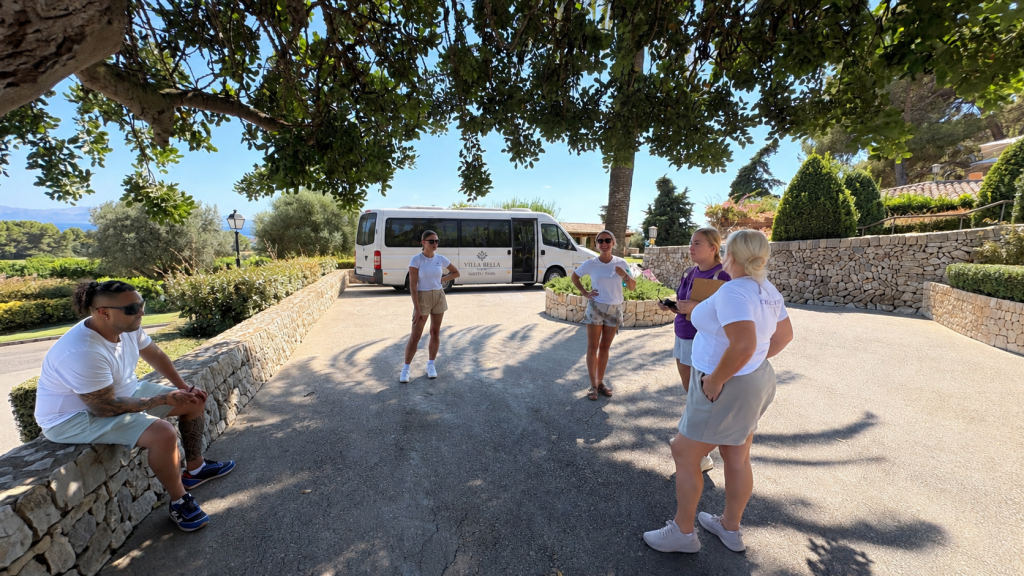
Each return should have a departure time, a boarding point, destinations, expected passengers and a transport contact. It also needs someone on the wedding team who confirms the vehicle is ready to leave and that no known guest has been left behind.
The driver drives the agreed route. Someone else checks the people. You should be doing neither. You are at your own wedding.
What the transport company needs to know
A quotation tells you what transport costs. A route sheet tells you whether it will work. Before anything is confirmed, the operator needs:
- the wedding date, venue name and exact location;
- the guest arrival time and expected number of passengers;
- hotel or meeting-point names, with numbers at each;
- proposed departure times and requested return times;
- the destination for each return;
- details of children and any reduced mobility;
- known entrance restrictions and the maximum vehicle size accepted;
- agreed drop-off and collection points;
- the planner’s contact and the operator’s operational contact.
Before the wedding, all of this becomes one final route sheet and one final passenger allocation. Your planner should hold that brief, so you are not the person the operator calls with questions.
Who pays for wedding-day transport?
There is no universal etiquette rule that you must pay for every journey your guests make in Mallorca. Guests usually cover their own flights and airport transfers. Wedding-day transfers are different. The wedding creates that journey, so many couples provide transport between recommended hotels and the venue. It also lets the planning team control arrival times and the late-night departure.
For the wider question, see who pays for what at a destination wedding in Mallorca. For a sense of scale, our Mallorca wedding cost guide gives indicative figures of roughly €1,200 to €3,500 for guest transport for 50 to 80 guests, depending on distance, duration and the number of vehicles.
Whatever you decide, tell guests before they book accommodation. “Transport will be provided from our recommended hotels” is useful. “We will arrange transport later” is not.
Frequently asked questions
Should we organise transport for all guests?
For a rural finca, yes, in most cases. Few guests want to arrange a late-night journey back from the countryside themselves. If everyone stays within walking distance of the venue, you may not need it at all.
Is one coach better than several minibuses?
One coach suits a group starting from one place, at a venue with suitable access. Smaller vehicles work better for dispersed hotels, narrow finca roads or staggered returns.
How many return times should we have?
For most weddings with older guests or families, two: an early return after the main formal moments and a final departure when the celebration ends. A small group with similar plans can manage with one.
Do we need a passenger list?
For organised group transport, yes. It shows who belongs at each collection point and who expects to take which return.
Who coordinates the driver on the day?
One operational contact should link the wedding team and the transport company. You should not be phoning drivers or deciding whether the last vehicle can leave.
Plan your wedding transport with Magdalena
When the plan works, nobody mentions it. The last coach leaves with everyone on board, and you hear about it the next morning, over breakfast.
Your venue decides which vehicles can arrive. Your accommodation decides where guests are collected. Your timeline decides when each group needs to travel. That is why Magdalena, your local wedding planner and celebrant, plans transport alongside the venue, the timings and your guests’ experience.
If you have a venue shortlist or a hotel plan, send Magdalena the venue, your expected guest number and the hotels or areas you are considering. She reviews every enquiry personally within 24 hours, and she will show you how hotels, venue and transport fit together and what needs answering before you commit. Start the conversation with Magdalena.

