

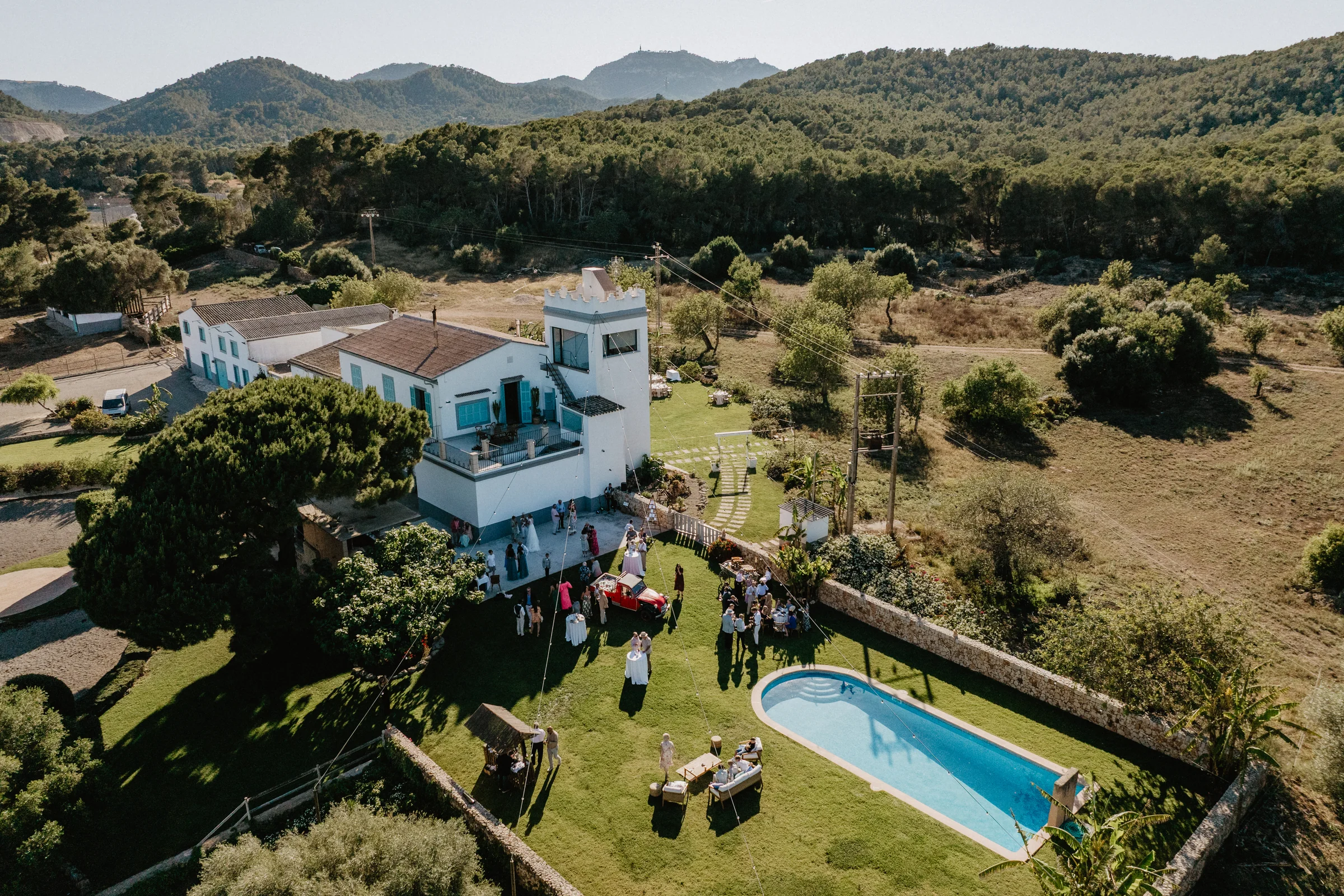
The five decisions that will shape your entire wedding experience.
Most couples begin planning their Mallorca wedding by looking for a venue. It feels like the obvious starting point — but it is rarely the first decision that should be made. Choosing a venue too early is one of the most common and most expensive mistakes international couples make, because the venue quietly shapes your guests’ experience, your budget and the flow of the entire day. Before you fall in love with a place, five earlier decisions deserve your attention.
Why the venue is rarely the right place to start
Beautiful fincas. Sea views. Olive groves. Private villas with the light doing something extraordinary at seven in the evening. It is easy to see why couples begin here.
But after years of guiding international couples through weddings on the island, we have noticed something that surprises almost everyone: the most beautiful location is not automatically the right one. Sometimes it is the very thing that creates problems for everything that follows.
A venue is not a decision you make in isolation. It sits at the centre of a system — accommodation, transport, guest comfort, supplier access, sound limits, ceremony timing and budget structure all connect to it. Choose the venue first, before you understand that system, and you spend the rest of your planning making compromises you didn’t need to make.
Below are the five questions that deserve your attention before you enquire about a single venue.
1. What kind of experience do you want your guests to have?

Start here, not with the setting. The experience your guests have — from the moment they land at Palma airport to the moment they leave — shapes your wedding far more than the colour of the flowers.
Many couples picture the ceremony in vivid detail. Very few picture what a guest actually does on arrival. Yet those practical realities are what people remember, and what quietly determines whether a wedding feels warm and connected or scattered and stressful.
Before anything else, it helps to ask:
- Will everyone stay in the same place, or spread across the island?
- Will guests need to hire cars, or will transport be arranged?
- How long are the transfers between accommodation, ceremony and dinner?
- Will older family members feel comfortable with the distances and timings?
- Will people actually spend unhurried time together, or only meet at the reception?
These are not logistical afterthoughts. They are the foundation of the day. A venue that looks perfect but leaves half your guests navigating an unfamiliar island in the dark is not the right venue — however beautiful the photographs.
2. Your venue should support your wedding, not dictate it

A spectacular finca is not automatically the right choice. The most striking location can create logistical challenges that ripple through the entire day.
In Mallorca specifically, the practical realities behind a beautiful setting are often invisible from a distance. Late-night transport can be difficult in remote countryside. Many venues carry strict noise restrictions that end the music earlier than couples expect. Accommodation may be scattered, catering options limited, and the nearest reliable suppliers an hour away.
Choosing well means understanding how each decision affects everything else. The right venue direction is the one where guest accommodation, transport, supplier access, ceremony timing and the flow of the evening can work together without friction — not the one that simply looks best on a screen.
This is where local knowledge changes everything. A place that feels like a dream in a gallery of images may hide a dozen constraints that only someone on the ground would recognise before it is too late to change course.
In Mallorca, the right venue is not the most beautiful setting. It is the place where accommodation, transport, supplier access, ceremony timing and the flow of the day can work together — so your guests are looked after, and you are free to be present.
If you’d like to see how these considerations play out in practice, we explore venue decisions in more depth in our guide to wedding venues in Mallorca and across The Mallorca Edit, our editorial video series on planning a wedding on the island.
3. Budget is about priorities, not a perfect number

One of the biggest misconceptions about destination weddings is that you need a precise figure before you can begin. In reality, experienced planning starts with priorities, not numbers.
A realistic Mallorca wedding budget typically starts from around €35,000, excluding guest accommodation — but the more useful question is not “how much” so much as “for what”. Where would you rather invest?
- An elevated guest experience, from welcome to farewell?
- Exceptional food and wine?
- Photography and film that hold the day forever?
- Comfortable, well-located accommodation?
- A longer celebration that gives everyone more time together?
Once you understand your priorities, every later decision becomes easier — including the venue. Money follows meaning, not the other way around. Couples who begin with a spreadsheet and no priorities almost always end up spending on the wrong things and feeling short-changed on the ones that mattered.
For a fuller sense of where the money genuinely goes, our honest breakdown of the true cost of a luxury Mallorca wedding is a good place to begin.
4. Planning from abroad changes everything

When you cannot visit every venue in person, when you don’t know the local suppliers, and when every recommendation looks flawless on Instagram — planning stops being about inspiration and becomes about trust.
This is the reality that most defines a destination wedding. From five thousand miles away, or even a two-hour flight, you are making significant decisions based on images and promises rather than first-hand knowledge. The gap between how a place photographs and how it actually works on a wedding day is exactly where costly mistakes live.
Working with someone who knows the island means decisions are grounded in reality rather than assumptions. It means having someone on the ground who can walk a venue, question a supplier, notice the thing that doesn’t quite add up, and tell you honestly when a beautiful idea won’t serve your guests.
For couples in the USA, it removes the timezone anxiety and the fear of having no representation locally. For couples in the UK, it means the ease of a short flight without sacrificing the certainty that everything on the ground is genuinely handled. In both cases, the value is the same: clear, realistic guidance instead of guesswork.
5. Your wedding should never become a logistics project

This may be the most important point of all — and it is where good planning quietly proves its worth.
Your family should not spend your wedding day answering suppliers’ questions. Your witnesses should not be coordinating transport. And you should not wake up that morning wondering whether everything is actually under control.
The best weddings often feel calm and effortless — not because they required less work, but because someone else quietly took responsibility for every detail. That sense of ease is not luck. It is the result of a plan held carefully in the background, so the people at the centre of the day are free to be fully present in it.
That freedom to be present is, in the end, what couples are really choosing when they choose a planner. Not the absence of logistics, but the certainty that the logistics belong to someone else.
The Dybiec Wedding perspective: the venue is part of a system

At Dybiec Wedding, we plan a limited number of weddings each year in Mallorca, guided personally by Magdalena — wedding planner, celebrant and personal guide on the island. This is deliberate. It allows every decision, from venue direction to the flow of the ceremony, to stay connected to one clear plan.
The family-led model behind the studio is a practical advantage, not a sentimental one. Because planning, ceremony, flowers, music and logistics stay connected from the very beginning, there is less risk of suppliers working in isolation, less friction between decisions, and a stronger sense that someone is holding the whole picture rather than a single piece of it.
There is also a quieter benefit worth naming. Because Magdalena can guide the planning and also lead the symbolic ceremony herself, the emotional centre of the day feels connected to the entire experience — shaped by someone who already knows your story, rather than added as a separate piece at the end.
None of this is about a longer or larger wedding. Whether your celebration is a single day or a slower multi-day rhythm of arrival, ceremony and farewell, the aim is the same: a more meaningful experience, held with care, in which you and your families can actually be present.
What couples tell us afterwards

The words we hear most often are never about flowers or decorations. They are about how the day felt — that they could finally relax into it, that their families were at ease, that everything simply flowed.
After her wedding at Villa Valens, Clara wrote that Magdalena’s calm, reassuring presence made her feel everything was under control — so that she, her family and her bridal party could fully enjoy the day without worrying about any logistics. Cindy described a wedding that went like clockwork and a planning process with the stress taken out of it, while Fanni remembered being able to simply enjoy every moment because everything had been so well organised.
For us, that is what successful wedding planning actually means. Not a perfect photograph, but a couple who were genuinely present at their own wedding.
Frequently asked questions
Should I choose my wedding venue in Mallorca first?
Usually not. It is better to first decide what experience you want your guests to have, understand your budget priorities, and consider how you’ll plan from abroad. The venue then follows naturally, because you’ll know which one genuinely supports your guests, your logistics and your vision — rather than dictating them.
How much does a wedding in Mallorca cost?
A realistic budget for a luxury Mallorca wedding typically starts from around €35,000, excluding guest accommodation. The final figure depends far more on your priorities — food, guest experience, photography, the length of the celebration — than on any single fixed number.
Can I plan a Mallorca wedding from the UK or the USA?
Yes, and most Dybiec Wedding couples do exactly that. The key is having someone on the ground who knows the island, the venues and the suppliers, so your decisions are based on local reality rather than on how a place looks online.
What is the biggest mistake couples make when planning a wedding in Mallorca?
Choosing the venue too early — before understanding how accommodation, transport, guest comfort, sound limits and budget all connect to it. A beautiful venue chosen in isolation often creates logistical challenges that shape the entire day.
Do I need a wedding planner for a destination wedding in Mallorca?
If you’re planning from abroad, a local planner removes the guesswork and the risk of costly mistakes made from a distance. Beyond coordination, the real value is guidance: someone who can tell you honestly what will and won’t work for your guests, before you commit.
Before you book anything
If you are still comparing wedding venues in Mallorca, budgets and ideas for your wedding in Mallorca, the most useful first step is not another shortlist — it is a conversation about direction.
Our first conversation is never about selling a package. It is about helping you understand which direction genuinely makes sense for your guests, your budget and the wedding you want to remember. Before committing to a venue, begin a private conversation with Magdalena to understand what would realistically work for you.
And if you’d like to prepare before that conversation, download The Mallorca Wedding Guide to understand the first decisions couples so often underestimate — and to arrive at your own planning with real clarity.


3 responses