
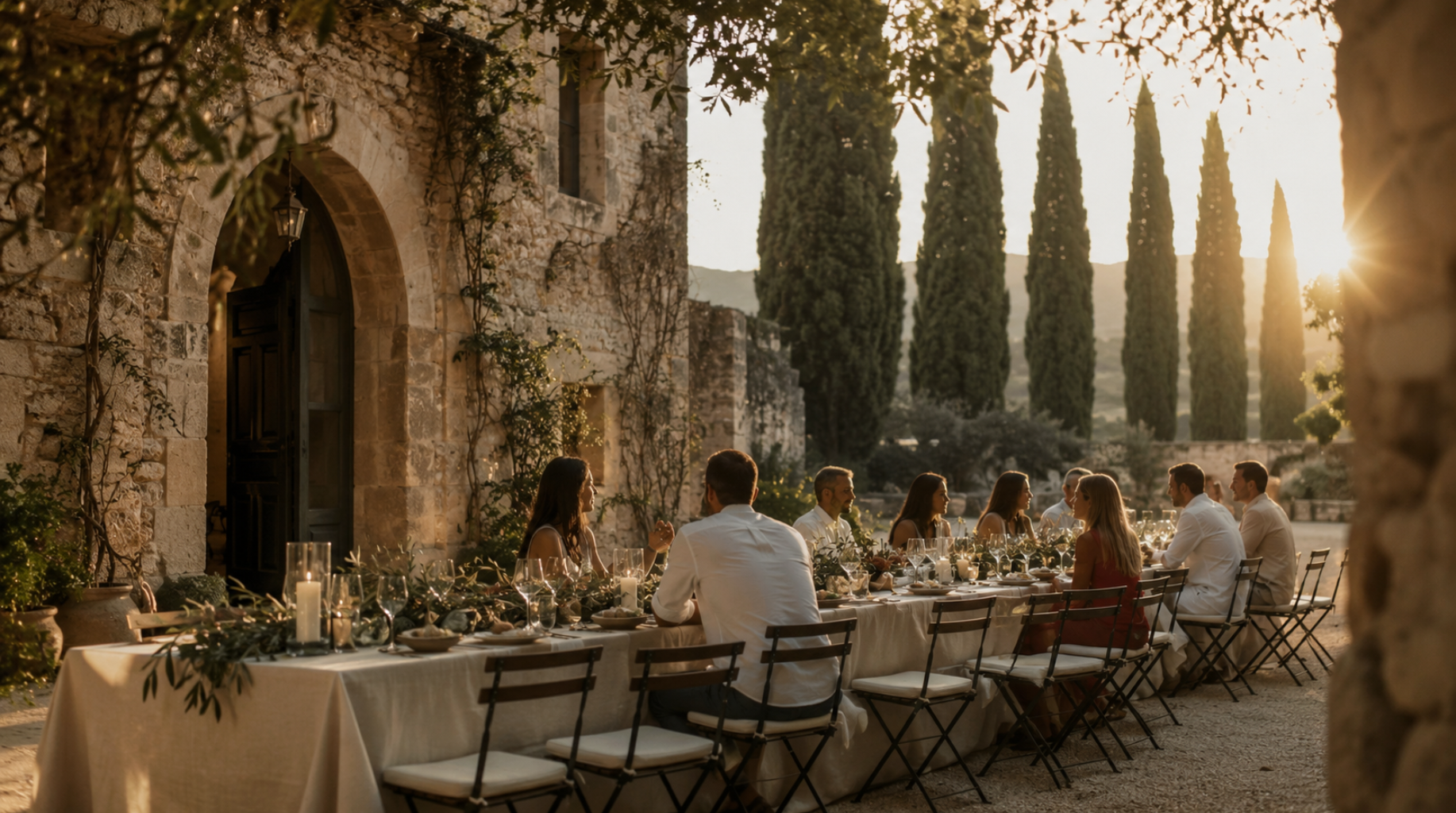
Whether your wedding day in Mallorca feels calm or chaotic comes down to three quiet decisions: how your guests eat together, how the day moves from one moment to the next, and who is holding everything behind the scenes. None of them are about how the wedding looks. All three decide whether you spend the day fully present — or quietly managing it.
In this article:
- Why the guest experience is decided long before anyone arrives
- Dining: the first thing that sets the tone of the evening
- Comparing the three dining styles
- Flow: how the day carries your guests
- The bar, and the shift from afternoon into evening
- Care: the part your guests never see
- The Dybiec Wedding perspective
- FAQ
The guest experience is decided long before anyone arrives
Most couples believe the feeling of their wedding day is set on the day itself. It isn’t. That calm — the sense that everything is handled and there is nothing to manage — is built months in advance, in decisions made by someone who knows this island from the inside.
Couples planning from the UK or the US often research the guest experience the wrong way round. They fall in love with a look on Instagram, then try to force it onto a venue and guest count it was never suited to. The calmer approach starts with three questions, not three moodboards: how do we want our guests to eat, how do we want the day to move, and who is going to hold it together while we’re actually living it?
Answer those early, and the rest follows. Leave them until later, and the gaps tend to show up on the day — usually as delays, mismatched pacing, or a beautiful venue quietly fighting the format you chose.
Dining: the first thing that sets the tone
The way a meal is served shapes how your guests talk, how they move, and how relaxed the room becomes. It quietly sets the tone for the whole evening — which is why it’s one of the first things worth thinking through, not one of the last.
Most couples choose a menu by asking, what would we like to eat? A better starting question is: how do we want our guests to feel around the table? Formal and composed, or warm and conversational? The answer points to a service style far more reliably than personal taste does.
A plated dinner: elegance you feel but never notice
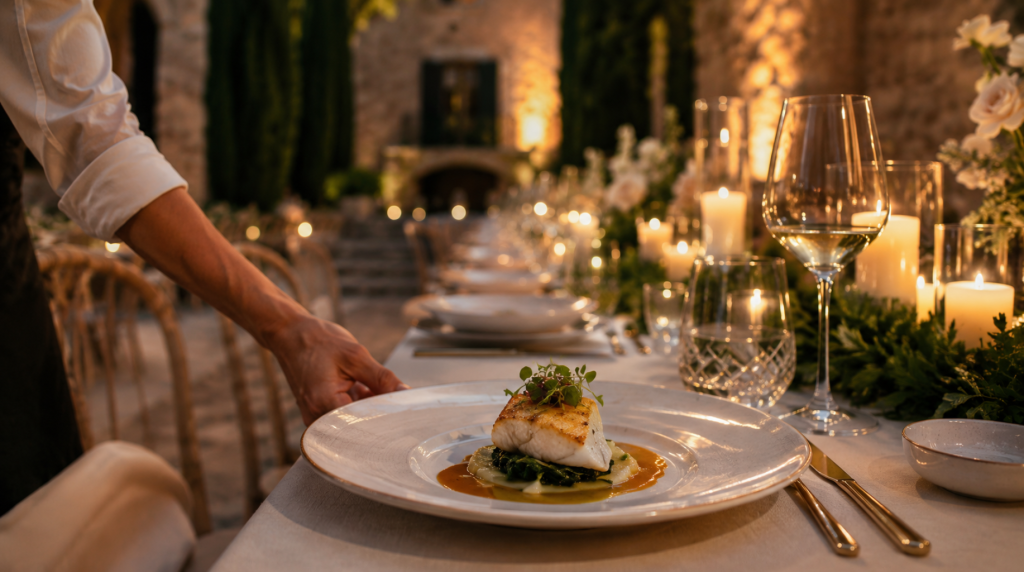
A plated dinner gives the evening a calm, unhurried rhythm — courses arriving in sequence, speeches and music landing on a timeline you can actually feel. That elegance depends entirely on timing you never see: every plate arriving together, every person serving knowing exactly where to be.
Done well, you notice none of it. You just feel a room that moves at the right pace. The trade-off is spatial. Plated service needs a proper kitchen — or a caterer’s mobile kitchen with real capacity — and a higher ratio of staff to guests to keep every table moving together. If your venue is a historic finca with a small original kitchen, that’s a question to raise before you commit to it, not after.
Sharing-style: warmth, not fashion

Sharing-style dining has become one of the most requested formats for Mallorca weddings — not because it’s fashionable, but because it’s warm. Large platters at the centre of long tables, guests passing dishes to one another, conversation staying open instead of pausing between courses. The room loosens without losing any of its quality. It suits finca and garden settings especially well, where the architecture already invites a relaxed, communal feel.
It asks something specific of your caterer: generous tabletop space, careful timing so platters are refilled before anyone notices a gap, and staff briefed to read the table rather than follow a fixed script. Done with the right team, it feels like the most natural thing in the world. Done without it, some tables are served well ahead of others — and the warmth slips.
Buffet and long-cocktail: movement over structure
Buffet service and the newer long cocktail format — a welcome drink that extends into three or four hours of small plates and food stations rather than a seated dinner — both prioritise movement. Guests choose when they eat, mingle freely, and there’s no seating chart to manage. These formats suit intimate weddings and beach-club settings, and tend to be the most forgiving option for a warm-weather island wedding, since nothing sits plated in the heat waiting for a synchronised course.
Comparing the three at a glance
Neither of these is a better choice than the others. Each is the right tool for a different kind of evening — and the decision that matters is matching the format to your venue, your guest count and the atmosphere you actually want, not the one that photographs best.
| Plated | Sharing-Style | Buffet / Long Cocktail | |
|---|---|---|---|
| Feel | Composed, unhurried | Warm, communal | Relaxed, social |
| Guest movement | Seated throughout | Seated, interactive | Free-flowing |
| Venue requirement | Full kitchen or build-out | Generous table space | Flexible layout |
| Best suited to | Formal timelines, speeches | Finca and garden settings | Intimate or beach settings |
Your table should reflect the two of you, not the current trend. That’s the kind of decision it helps to make with someone who has watched hundreds of these evenings unfold, and knows how each one actually feels once the guests sit down.
Flow: how the day carries your guests
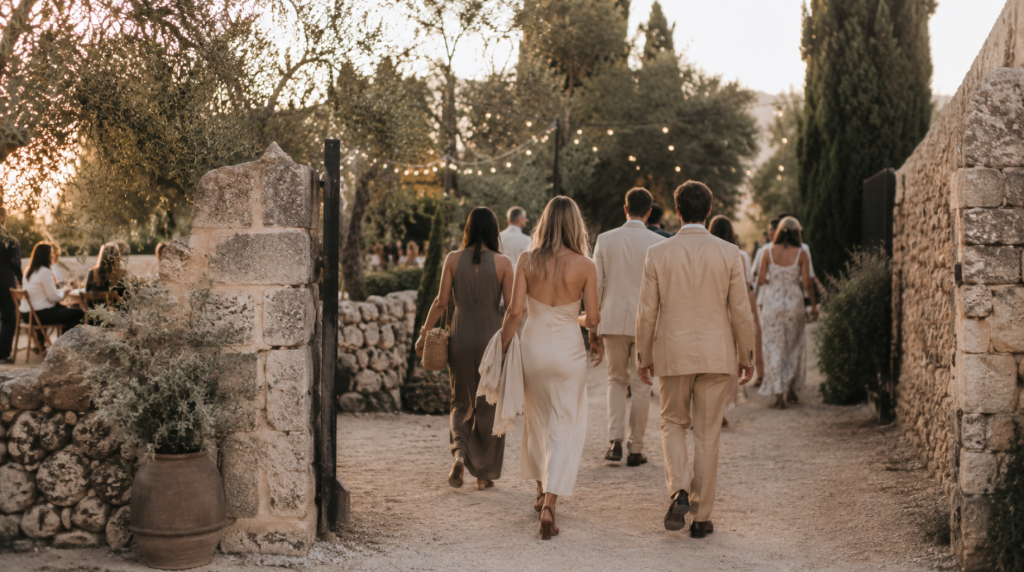
The weddings that feel calm are the ones where guests never have to wonder what happens next. They move naturally from one moment to the next, and every step simply belongs. You don’t feel managed. You feel carried. That is what a planner is really designing when they design a timeline — not a schedule, but a feeling of being looked after.
In Mallorca this matters more than almost anywhere, because the island itself changes in the late afternoon. The light softens, the heat drops, and the whole mood shifts. Leave that shift to chance and your guests feel a gap — a moment where the day seems to pause and no one is quite sure what to do. Plan for it deliberately, with a change of pace and a change of drink, and they never feel two separate events. They feel one continuous day that carries them from afternoon into evening without a seam.
The bar, and the shift into evening
Most people think of drinks as something you simply keep topped up. It’s more useful to think of them as part of the rhythm of the day. A welcome drink settles arriving guests and builds a little anticipation. Wine belongs to dinner. Something different again lifts the evening. None of this is complicated — but it’s exactly the sort of detail that makes guests feel quietly looked after, without ever knowing why.
A curated bar — complimentary wine and beer with a defined spirits selection, or a small number of signature drinks — tends to suit this pace better than a fully open bar. It keeps service measured without ever feeling restrictive. In Mallorca specifically, glassware, drink temperature and staff positioning often need to change as the light changes. It’s a detail most couples never think about until it’s handled, or isn’t.
Care: the part your guests never see
The third question is the one couples almost never think about — and it’s the one that decides whether the other two hold. Who is actually holding the day together?
Power. Transport. Staffing. Timings. The plan for when something doesn’t go to plan. None of it is glamorous, and none of it belongs on your plate on the morning of your wedding, from abroad. This is where couples planning from overseas most often underestimate the real work. It isn’t the styling or the menu tasting that determines whether a wedding feels calm — it’s whether someone has already resolved the practical questions before you ever arrive.
This matters most in the historic fincas so many couples fall in love with. They’re breathtaking, but they were never built to host a modern celebration — often no proper kitchen, limited power, tight access. None of that has to be your problem. With someone local holding it, you get to enjoy a place that feels timeless while someone on the ground makes sure it actually works on the day. The calmer a day looks from where you’re standing, the more someone has quietly taken off your plate.
For a fuller picture of how these decisions sit inside an overall budget, our guide to what a Mallorca wedding really costs walks through where couples typically under- and overestimate. And if the number of moving parts is already starting to feel like a lot, you’re not alone — why couples feel overwhelmed planning a wedding in Mallorca looks at why that happens, and what actually settles it.
The Dybiec Wedding perspective

We don’t treat dining, flow and infrastructure as three separate bookings. They’re one system. Planned separately — by suppliers who’ve never spoken to each other — the gaps show up on the day. Planned together, they disappear.
Because planning, styling and, when couples choose it, the ceremony itself sit under one roof at Dybiec Wedding, these decisions get made together rather than negotiated between strangers. Urszula’s decoration and Jimy’s music are briefed against the same service timeline as the catering, so the pacing of the room, the flowers and the playlist are never working against each other. Magdalena, who guides the planning, is the same person holding the details on the day — which is why, from where you’re standing, it simply feels calm.
That’s what we’re really planning for. Not a more elaborate wedding. A day where you never once have to think about how it’s all working — where there’s nothing to manage, nothing to check, just the day and the people you’re sharing it with.
FAQ
What’s the most popular catering style for Mallorca weddings? Sharing-style dining has become one of the most requested formats in recent years, particularly for finca weddings, because it suits the relaxed, communal character of the setting. Plated service remains the preferred choice for larger, more formal celebrations where speeches and timing need a fixed structure.
Can we mix catering styles at one wedding? Yes. Many couples choose sharing-style starters with a plated main, or a seated dinner followed by a late-night food station. The key is briefing your caterer clearly so staffing and timing are planned for the hybrid, not improvised on the day.
Does our venue limit which catering style we can choose? Often, yes. Historic fincas with small original kitchens may need a mobile kitchen brought in for plated service, and some venues restrict open flames or generator noise. This is worth checking before you commit to a venue, not after.
How far in advance should catering and bar service be finalised? Most couples confirm the overall format 9–12 months out and finalise menus closer to the day through tastings. Planning from abroad doesn’t change this timeline — it just means the conversations happen by video call rather than in person.
What happens if the weather changes on the day? A genuine backup plan means an alternative space — often an interior room at the same venue — with furniture and layout already agreed in advance, so a shift indoors never feels like an improvisation to your guests. Knowing that plan exists is a large part of what lets you relax.
The guest experience isn’t decided by the menu or the flowers. It’s decided by whether your dining, your flow and the person holding the details were planned as one thing — so that on the day, there is genuinely nothing left for you to manage. If you’d like to think this through properly, begin a private conversation with Magdalena about what would work for your wedding, or download The Mallorca Wedding Guide for a fuller look at the decisions that shape a Mallorca wedding.
