
If you and your partner come from two languages — and your guests from several more — the hardest question of your wedding is not the venue or the flowers. It is this: when you say the words that matter most, will the people who love you actually understand them? A multilingual wedding ceremony in Mallorca solves this without using headsets and hired translators. It relies on a celebrant who leads the ceremony itself across two or three languages. Written transcripts of the vows and key readings mean no guest ever stands outside the moment.
For an intercultural couple, that is the difference between a ceremony everyone attends and a ceremony everyone shares. This guide explains how a genuinely multilingual ceremony works in Mallorca, and why the usual advice — “just hire an interpreter” — quietly misses the point.
Contents
- Multilingual wedding ceremony in Mallorca: the short answer
- Why the standard advice falls short
- What a multilingual wedding ceremony in Mallorca actually looks like
- The transcript: why we prepare it as standard
- Two languages, one emotional thread
- The celebrant who also plans your wedding
- The Dybiec Wedding perspective
- Planning a bilingual ceremony from abroad
- FAQ
Multilingual wedding ceremony in Mallorca: the short answer
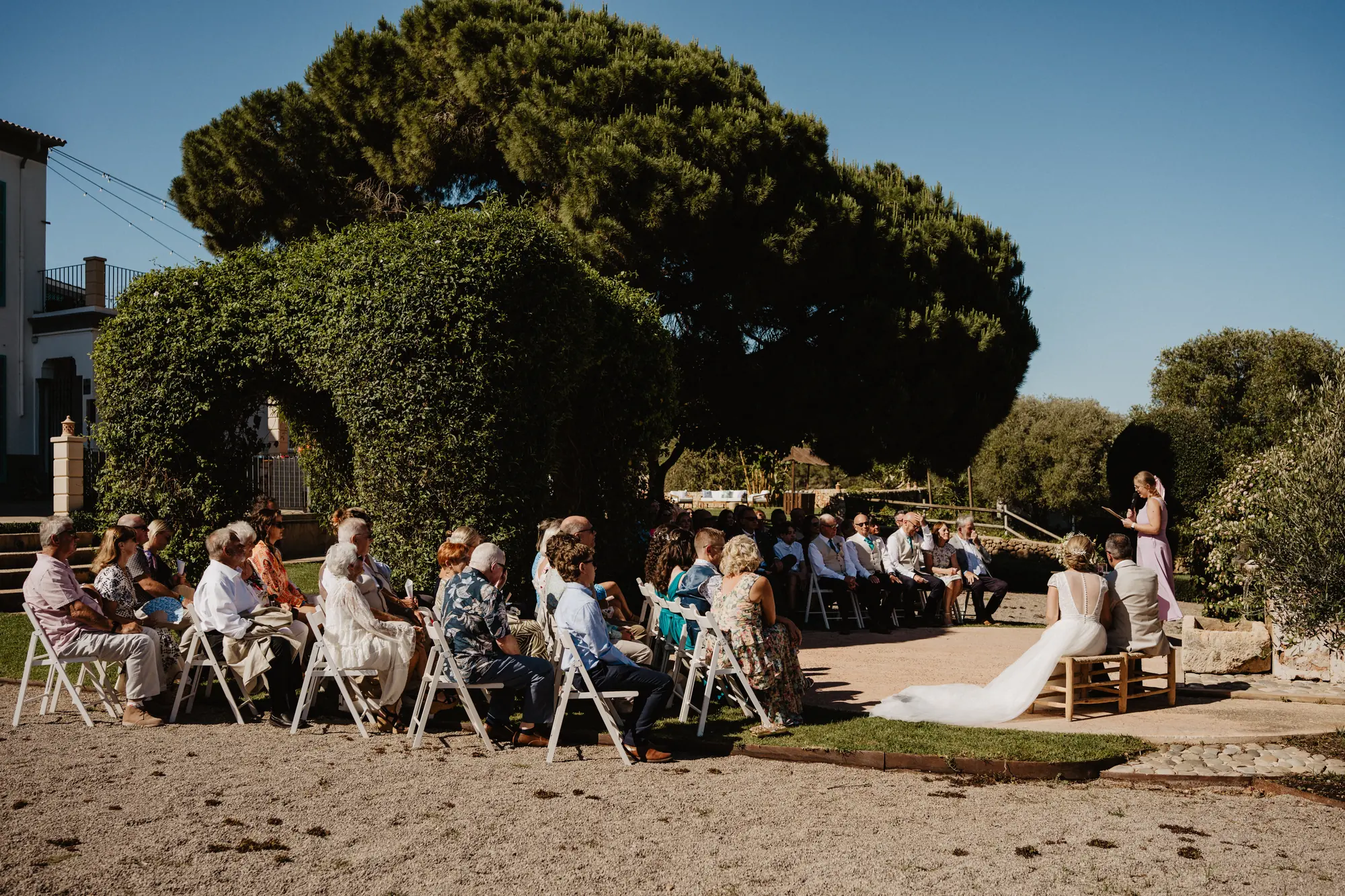
A multilingual wedding ceremony in Mallorca is one that a celebrant leads, not merely translates, in more than one language. That way, every guest experiences the ceremony as it happens rather than reading a summary afterward. This is especially common for couples marrying across cultures: a Polish–Spanish pairing, a British–German one, an American marrying into an Italian family.
Done well, it does not feel like a ceremony performed twice. It feels like one ceremony that happens to speak everyone’s language. That effect is the whole craft, and technology does not achieve it. A celebrant who holds both languages does, together with preparation that begins months before the day.
Why the standard advice falls short
Search for help with a multilingual wedding, and most advice tells you to hire a translator with wireless headsets, print bilingual invitations, and seat guests who share a language. All of this is practical. None of it touches the ceremony itself.
Here is the problem. A translator working from the back of the room turns your vows into a running commentary — a half-second behind, in a flat register, over headphones. The most intimate words of your life arrive for half your guests as logistics. The emotion does not survive the relay. Technology can transmit meaning; it cannot carry feeling. And a wedding ceremony is almost entirely feeling.
Most tools on offer serve information: an RSVP form, a schedule, a venue address. No one designed them for the one part of the day where being present matters more than being informed. That gap is exactly where a multilingual ceremony either works or falls apart.
What a multilingual wedding ceremony in Mallorca actually looks like

When Magdalena leads a ceremony in two or three languages, the languages are woven, not stacked. A welcome in Spanish; the couple’s story in English; a blessing returned to the family’s mother tongue. Magdalena designs the structure so that no group spends too long outside their own language. The rhythm never sags into repetition.
The vows are the heart of it. Rather than saying everything twice, Magdalena shapes the ceremony so each language carries part of the emotional weight. One partner may speak their vows in their own language after she has already opened the meaning to the room. When the words come, everyone already holds them. The grandmother who speaks no English still understands, at the moment, exactly what the couple is promising. That is the entire point.
Nobody improvises any of this on the day. Magdalena writes, paces and rehearses it in advance, in close conversation with the couple. That is only possible when the person leading the ceremony is also close to the planning.
The transcript: why we prepare it as standard

At Dybiec Wedding, every guest at a multilingual ceremony can receive a written transcript of the vows and the most important readings and speeches, in the languages present. This is not an add-on. It is standard because it solves something an interpreter cannot.
A spoken translation vanishes the moment someone says it. A transcript stays. With it, a guest can follow the vows in their language as the couple speaks them, look up at the right moment, and keep the words afterward. One parent can read their speech in their own language, and the other side of the family still understands it, without a microphone passing between tables. The ceremony turns from something guests witness into something they hold, during and long after.
For an intercultural family, this small printed thing carries a lot of weight. It says, plainly: you were expected here, and nothing about this day was going to leave you out.
Two languages, one emotional thread
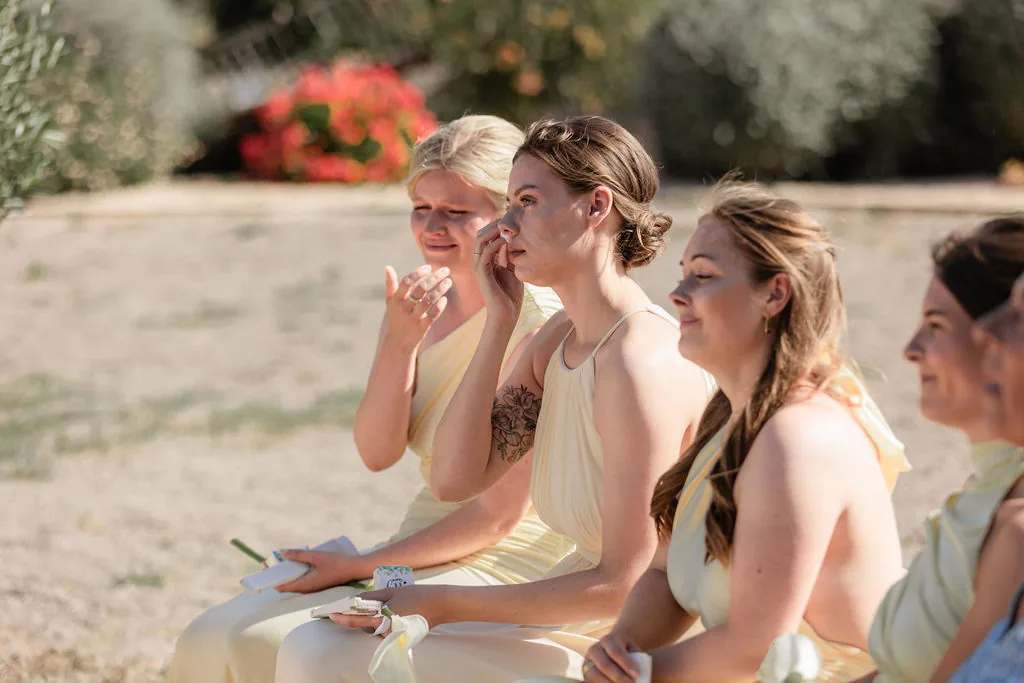
The risk in any bilingual ceremony is that it becomes administrative — a bureaucratic doubling, everything announced twice until the feeling drains out of it. Avoiding that is a matter of design, not translation.
The thread that holds it together is the couple’s own story. When the celebrant has spent months coming to understand who you are, the ceremony can move between languages without ever losing its centre because the centre is you — not the mechanics of switching tongues. Language becomes a way of including people, rather than a task to get through.
The celebrant who also plans your wedding
This is where a Mallorca ceremony guided by Magdalena differs from the usual arrangement, where a couple plans with one company and meets their officiant shortly before the day.
Because Magdalena can guide your planning and lead your symbolic ceremony, the emotional centre of the day connects to the entire experience, rather than arriving as a separate piece at the end. She learns your story while helping you shape the wedding — and then carries that same understanding, in the right languages, into the ceremony itself. For a multilingual couple, this continuity matters even more than usual. The person choosing how your two languages meet is the person who already knows what each one means to you.
You can read more about Magdalena’s background as planner and celebrant here.
The Dybiec Wedding perspective
Most of what makes a wedding feel seamless is invisible, and a multilingual ceremony is the clearest example. When it works, no guest notices the design. They simply feel included, which is the rarest and most valuable thing a ceremony can offer a room full of people from different countries.
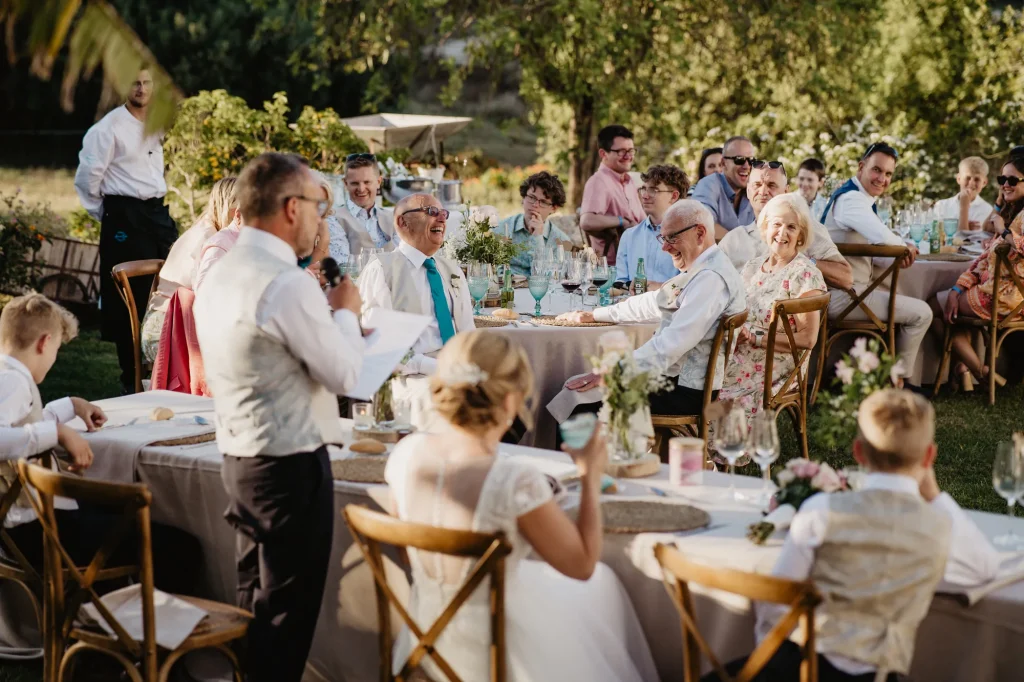
The family-led structure behind Dybiec Wedding keeps this possible. Planning, ceremony, music, and logistics stay connected from the beginning. That way, we consider the languages of your ceremony alongside everything else: the pacing your florist’s timeline leaves for the readings, the moment the music should shift, the pause where a translation should land. We never treat it as a separate translation problem to outsource. It is part of the whole.
For couples weighing what all of this involves — including budget — our honest overview of what a Mallorca wedding really costs is a grounded place to start, and the FAQ answers the practical questions couples ask most.
Planning a bilingual ceremony from abroad

If you are organising this from another country, the reassuring part is that the ceremony’s language design is one of the things best handled on the ground. You do not need to solve it yourself. The work is in the conversations. You tell the celebrant who your families are, which languages carry which meaning, and where the emotional weight of your story sits. From there, the shaping of the ceremony is ours to hold.
The first step is simply a conversation. Speak with Magdalena about how your languages could meet in your ceremony — or download The Mallorca Wedding Guide to understand how the whole day fits together before you commit to anything.
FAQ
Can we have a multilingual wedding ceremony in Mallorca?
Yes. A symbolic ceremony has full flexibility of language, structure, and content. It can be led in two or three languages, which makes it the natural choice for intercultural couples whose guests do not all share one language.
How is a multilingual ceremony different from hiring an interpreter?
An interpreter translates from the side, a beat behind, usually over headsets. The emotion rarely survives. A multilingual ceremony is led in each language by the celebrant, so every guest experiences the ceremony directly rather than as a relayed translation.
Do you provide translations of the vows for guests?
Yes — at Dybiec Wedding, we prepare written transcripts of the vows and key readings and speeches, in the languages present, as standard. Guests can follow the most important words in their language as the couple speaks them, and keep them afterward.
Which languages can a multilingual wedding ceremony in Mallorca include?
Magdalena leads ceremonies across multiple languages. The right combination depends on your families and guests, which is one of the first things worked out together when shaping the ceremony.
Is a multilingual wedding ceremony in Mallorca legally binding?
It is a symbolic ceremony — deeply personal and fully flexible, but not the legal marriage itself. Most international couples complete the legal formality privately at home and treat the Mallorca ceremony as the real, meaningful celebration. This is the most common and least stressful route.
We’re an intercultural couple planning from abroad — when should we start?
Early, because we weave the language design of the ceremony into the wider planning, rather than bolting it on at the end. The sooner the celebrant understands your story and your families, the more naturally the two languages can meet on the day.

