
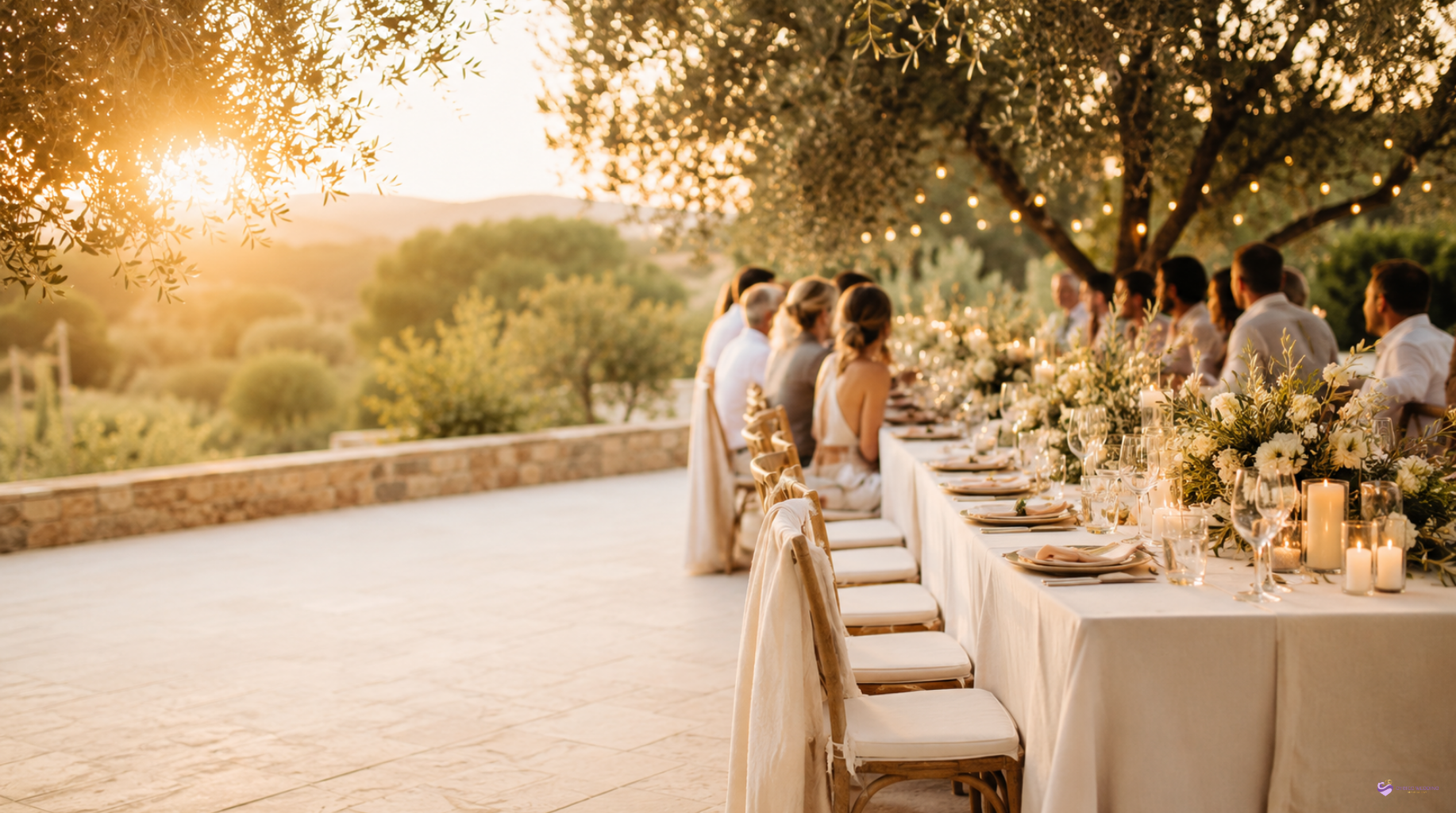
One day or three? Neither format is more premium than the other. A one-day wedding in Mallorca and a three-day celebration answer different questions — not different budgets, and not different levels of ambition. One single day is complete in itself: ceremony, dinner, music, the people you love, the emotional centre of the whole thing. Extending it to two or three days does not make that day bigger. It changes what happens around it — how guests arrive, how they settle, how they leave. The right choice depends on where your guests are travelling from, how much time they have, and what you want them to carry home.
This is one of the first decisions couples ask Magdalena about — usually after they have already fallen in love with a venue, and occasionally after they have already booked one. That order creates problems. The format shapes the venue requirements, not the other way round.
So it is worth understanding what each structure actually does.
What a One-Day Wedding in Mallorca Actually Is
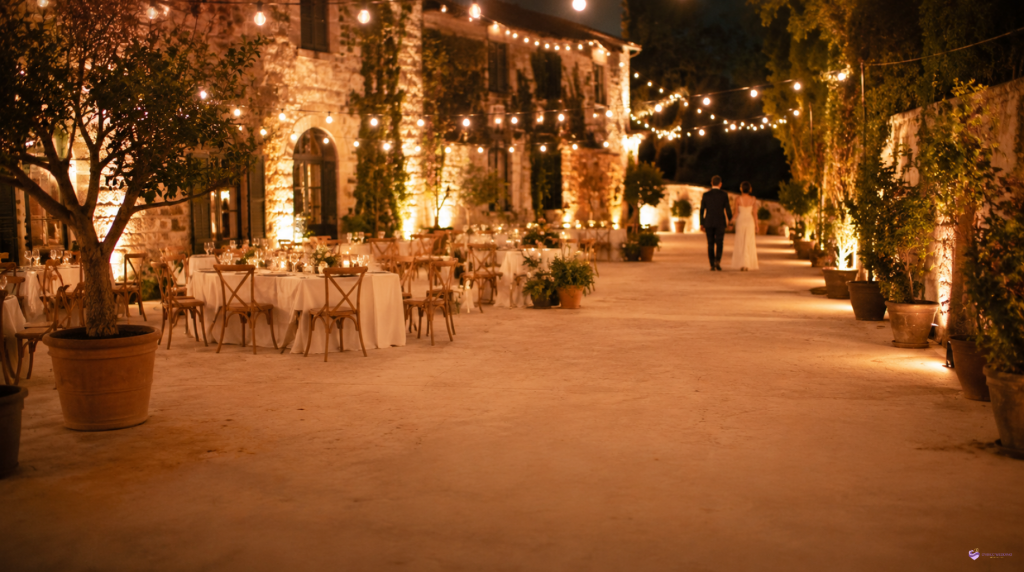
A one-day wedding in Mallorca is a full celebration. Ceremony, aperitif, dinner, music, dancing, the slow walk back through the courtyard at one in the morning. Everything that matters happens.
The wedding day is the emotional foundation of every celebration Dybiec Wedding designs — regardless of how many days surround it. When the timeline moves with purpose, when transfers arrive quietly and on time, when the ceremony catches the softest hour of evening light rather than the hardest hour of afternoon sun, a single day in Mallorca is not a reduced version of anything.
It is the whole thing.
A one-day format tends to work well when:
- your guest group is largely travelling from within Europe and can arrive and depart around a single date without difficulty
- your guests have limited leave and you would rather they come for one perfect day than half-attend three
- you want the celebration to have a single, concentrated emotional peak
- you would prefer to invest the budget in the depth of one day rather than the breadth of three
That last point matters more than couples expect. The same budget spread across three days produces a different experience than the same budget concentrated into one. Neither is better. They are simply different shapes.
Magdalena — as your wedding planner, celebrant and personal guide — works to the same standard in both. A one-day wedding is not the entry point to the three-day version. It is a complete commission in its own right.
What a Multi-Day Structure Actually Changes
A two- or three-day wedding does not make the wedding day longer, louder or more expensive. The wedding day stays exactly what it is.
What changes is the space around it.
A welcome gathering the evening before. The wedding day itself. A farewell brunch the following morning — long, unhurried, in the shade, before people begin to travel home.
The difference this makes is not to you. It is to your guests.
When people fly from London, Manchester, New York or Sydney to attend a wedding, they arrive with a certain amount of travel still in them. They land, they find their room, they change, and then — in a one-day format — they walk more or less straight into your ceremony. That is entirely workable. It happens beautifully all the time.
But a welcome evening does something specific: it lets guests arrive before the wedding begins. They meet each other and adjust, slowly stepping out of travel mode. Guests stop being travellers and start being, well, guests. By the time your ceremony begins, the room already knows itself.
And a farewell gathering does the reverse. It gives the celebration an ending rather than a departure.
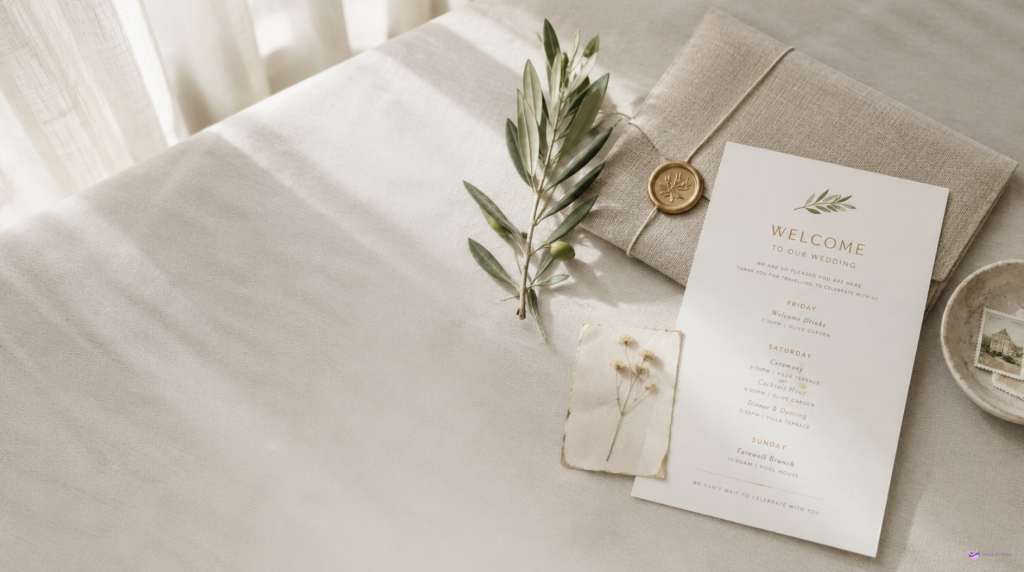
Who a Multi-Day Structure Actually Suits
A multi-day structure tends to be the right answer when:
- your guests are travelling long-haul — particularly from the USA, where the flight alone makes a one-night trip impractical
- your guest group is coming from several countries and does not yet know each other
- the people closest to you are the reason you are doing this at all, and you want actual time with them rather than eleven seconds each in a receiving line
- your venue and accommodation naturally support a group staying together for several nights
It is the wrong answer when couples choose it because it sounds more impressive. A three-day wedding built for the wrong reasons is simply an expensive one-day wedding with two tired days attached.
If you are weighing the two structures, The Mallorca Wedding Guide sets out what each format involves in practical terms — accommodation, transfers, budget shape and guest time.
The Real Question Underneath the Format
Most couples think they are choosing a length. They are actually choosing how much responsibility they will carry for their guests.
This is the part that catches people.
At a one-day wedding with international guests, a great deal happens around the day that someone has to handle. Where is everyone staying. How are they getting from the airport. What time does the shuttle leave. Does your aunt know the ceremony is outdoors and the ground is gravel. Has anyone told the group from New York that the reception runs until two.
If nobody is holding that, it finds its way to you. Usually about an hour into your own reception, standing slightly apart from the party, phone in hand.
At a multi-day wedding, that responsibility does not go away — it multiplies. Three days of accommodation, three days of movement, three days of people needing to know where to be.
So the format question is really two questions:
- What structure serves your guests?
- Who is going to hold it?
The second one determines whether the first one works.

Three Things That Decide the Format More Than Preference Does
Where your guests are flying from
This is the single strongest input. A guest group that is 80% UK-based, flying two and a half hours from Gatwick, can comfortably attend a one-day wedding and treat it as a long weekend of their own making.
A guest group flying from the US East Coast is looking at a full travel day in each direction. Asking them to do that for a single evening is a genuine ask — and many couples find that once they book the flights, guests are staying four or five nights anyway. At which point the question is not whether there will be a multi-day experience, but whether someone designs it or it simply happens.
Where everyone is staying
If your guests scatter across six hotels in three towns, a multi-day structure becomes logistically expensive very quickly — a great deal of movement for relatively little connection.
If the group can stay together, or close together, the welcome evening and farewell brunch become almost effortless to run, because the people are already there.
Accommodation strategy is not an administrative detail that follows the venue decision. It is one of the inputs to it. This is one of the reasons Magdalena works with couples on the decisions that come before the venue rather than after.
What your budget is actually being asked to do
A three-day wedding does not cost three times a one-day wedding. But it does cost more — additional venues or spaces, additional catering, additional transfers, additional hours of coordination.
The honest version of this conversation is that the same figure will buy you a deeper single day or a broader three days. Dybiec Wedding’s one-day celebrations begin from €35,000, excluding guest accommodation. What that figure buys changes shape depending on the structure you choose. The Mallorca wedding budget breakdown sets out where the money actually goes in each case.

Why Magdalena Would Rather Discuss the Format Before the Venue
Most couples arrive at the first conversation having already found the finca.
It is understandable — the venue is the visible part, the part that photographs, the part that made you think about Mallorca in the first place. But a venue that is perfect for a concentrated one-day celebration may be structurally wrong for a three-day one, and the reverse is equally true.
A venue with limited on-site accommodation works beautifully for a single day and becomes a transport problem across three. One with a restrictive sound curfew shapes what an evening can be. And one an hour from where your guests are staying costs you time you will only notice you have lost on the day itself.
The format determines the venue brief. Deciding the venue first means deciding the format by accident.
This is the work Magdalena does before you book anything: understanding who is coming, from where, for how long, and what you actually want them to experience — and only then identifying which venues can hold it.
Magdalena stays involved from that first conversation through to the last transfer of the final night. She is not a coordinator who appears the week before with a folder — she is the person who knows why you made every decision, because she was there when you made it.

The Dybiec Wedding Perspective: Format Is Not a Measure of Ambition
There is a quiet assumption in destination wedding culture that longer means more serious. That a three-day celebration signals a certain level of commitment, and a one-day wedding signals something less.
This is not how it works, and couples who believe it tend to make expensive decisions for the wrong reasons.
A one-day wedding for forty people, precisely timed, with guests who feel properly looked after and a couple who are genuinely present for all of it, is a better wedding than a three-day celebration that couples chose because it sounded like the thing one does.
The wedding day is the foundation. It is where the ceremony happens, where you say your vows, where the room goes quiet. Nothing added around it improves that. A welcome evening and a farewell brunch exist to serve the guest experience — to give people time and space around the centre of the thing.
They are a different structure. They are not a higher tier.
Dybiec Wedding designs both to the same standard, and Magdalena will tell you plainly if she thinks you are choosing the wrong one.
What This Decision Really Protects
The point of getting the format right is not elegance. It is presence.
You have one evening — or one weekend — in which the people you love most are all in the same place at the same time, which will very likely never happen again in exactly this configuration. What you want from that is not a schedule that ran on time. It is to have actually been in it.
Not standing at the edge of your own reception answering a question about a shuttle. Not lying awake the night before running through the arrivals list. And not realising, three months later, looking at the photographs, that you were there but you were not quite present.
The right format makes that possible — but only when someone who knows Mallorca from the inside is holding it.
Before You Choose a Venue, Choose a Direction
The most useful thing you can do at this stage is not to shortlist fincas. It is to work out what shape your celebration needs to be — and to do that with someone who knows what each shape actually costs, in money, in time and in guest goodwill.
If you would like to understand which format would genuinely work for your guests, your budget and the kind of day you want to have, begin a private conversation with Magdalena.
And if you would rather read first, The Mallorca Wedding Guide covers both formats in detail, including what each one asks of your guests.
Watch: The Mallorca Edit
In this episode of The Mallorca Edit, Magdalena talks through the part of a destination wedding couples most often underestimate — how Magdalena looks after guests across the days around the wedding, and why that quietly shapes everything else.
Frequently Asked Questions
Is a one-day wedding in Mallorca less premium than a three-day one? No. A one-day wedding is a complete celebration, not a reduced version of a longer one. The wedding day is the emotional foundation of every format — ceremony, dinner, music, the people who matter. A multi-day structure does not improve the wedding day; it changes what happens around it, primarily for the benefit of guests who have travelled a long way. Dybiec Wedding designs both to the same standard.
How do I know which format is right for us? Start with three inputs: where your guests are flying from, whether they can realistically stay together, and what you are asking your budget to do. Guests travelling long-haul from the USA usually stay several nights regardless — which makes a designed multi-day structure worth considering. A largely UK-based group flying two and a half hours can attend a one-day wedding comfortably. Magdalena works through this before you discuss any venue.
Does a three-day wedding cost three times as much? No — the wedding day itself is unchanged. What increases is the surrounding structure: additional spaces, catering, transfers and coordination hours. The more useful way to think about it is that the same budget will buy a deeper single day or a broader three days. Dybiec Wedding’s one-day celebrations begin from €35,000, excluding guest accommodation.
Should we choose the venue or the format first? The format. A venue that suits a concentrated one-day celebration may be structurally wrong for a three-day one — limited on-site accommodation, distance from where guests are staying, or a sound curfew that shapes what the evening can be. Choosing the venue first means choosing the format by accident.
Planning the Details
What does a three-day wedding in Mallorca typically include? Usually a welcome gathering on the first evening, the wedding day itself, and a farewell brunch or relaxed gathering on the final morning. The structure follows the couple’s priorities rather than a fixed formula — some couples want an intimate dinner for close family the night before, others a relaxed welcome for the whole group.
Is a multi-day wedding only for large guest lists? Not at all. Some of the most successful multi-day weddings are intimate celebrations of thirty or forty people. The format follows the guest journey, not the guest count. A small group flying from three continents may benefit far more from a welcome evening than a large group who all live within an hour of Palma.
What time should the ceremony be, in summer? Late afternoon or early evening — generally from around 6pm in the summer months. The light is softer, the temperature is comfortable for guests sitting outdoors, and the progression into dinner is unhurried. Magdalena plans ceremony timing as part of the wider day, not as a separate decision.
Dybiec Wedding works with a limited number of couples each year. If you are beginning to plan a destination wedding in Mallorca, it is worth reaching out early — both to check availability and to give the decisions the time they deserve.
