
If you are a US couple dreaming of marrying in Mallorca, here is the short, honest answer: yes, you can absolutely have your wedding here. But for most American couples, the smoothest path is to complete the legal side at home and hold a symbolic ceremony on the island. It sounds like a compromise. In practice, it usually gives you more freedom, not less.
Below, we explain why — calmly, and from the perspective of someone who lives and works on the island.
Can US couples legally marry in Mallorca?

The most useful way to think about this is not “where do we want to celebrate?” but “where do we actually live?”
A civil marriage in Mallorca generally suits residents — couples who officially register as living on the island. If that is you, a Spanish civil ceremony at a local registry office or town hall is open to you.
For non-residents — which includes almost every couple travelling from the United States — a Spanish civil marriage is not usually the practical route. Spain built the civil process for people who live on the island. The administrative side can be slow, document-heavy and difficult to manage from thousands of miles away. It is rarely the part of your wedding you want to spend your energy on.
This is not a limitation on your wedding. It simply shapes how the legal moment happens. And it points most couples towards a path that is both simpler and, in our experience, more beautiful.
The path most US couples actually take
Here is what the majority of our international couples do, and what we would gently guide most American couples towards.
You complete the legal marriage at home. It’s often a short, private appointment at your local courthouse or registry office, in the days or weeks before you fly. It is quiet and quick. And it stays entirely separate from the celebration. Many couples treat it as an intimate moment in itself.
Then, in Mallorca, you hold the ceremony that actually feels like your wedding. The vows happen in front of everyone you love, in a setting you have chosen — unhurried and deeply personal.
The paperwork is done. The pressure is gone. And what remains on the island is pure celebration.
This is where a lot of anxiety quietly lives for American couples, so let us say it plainly. The legal marriage you complete at home is your legal marriage. The symbolic ceremony in Mallorca does not replace it or compete with it — it celebrates it. There is no gap, no grey area, nothing left uncertain when you return home.
What a symbolic ceremony really is — and why it gives you more, not less

A symbolic ceremony is not a lesser version of a wedding. It is a full, structured ceremony — vows, rings, readings, an officiant, witnesses. It is identical in every way that matters to you and your guests. The only difference: you handle the legal paperwork separately, at home. Nobody watching would know, and the photographs are exactly the same.
What changes is your freedom.
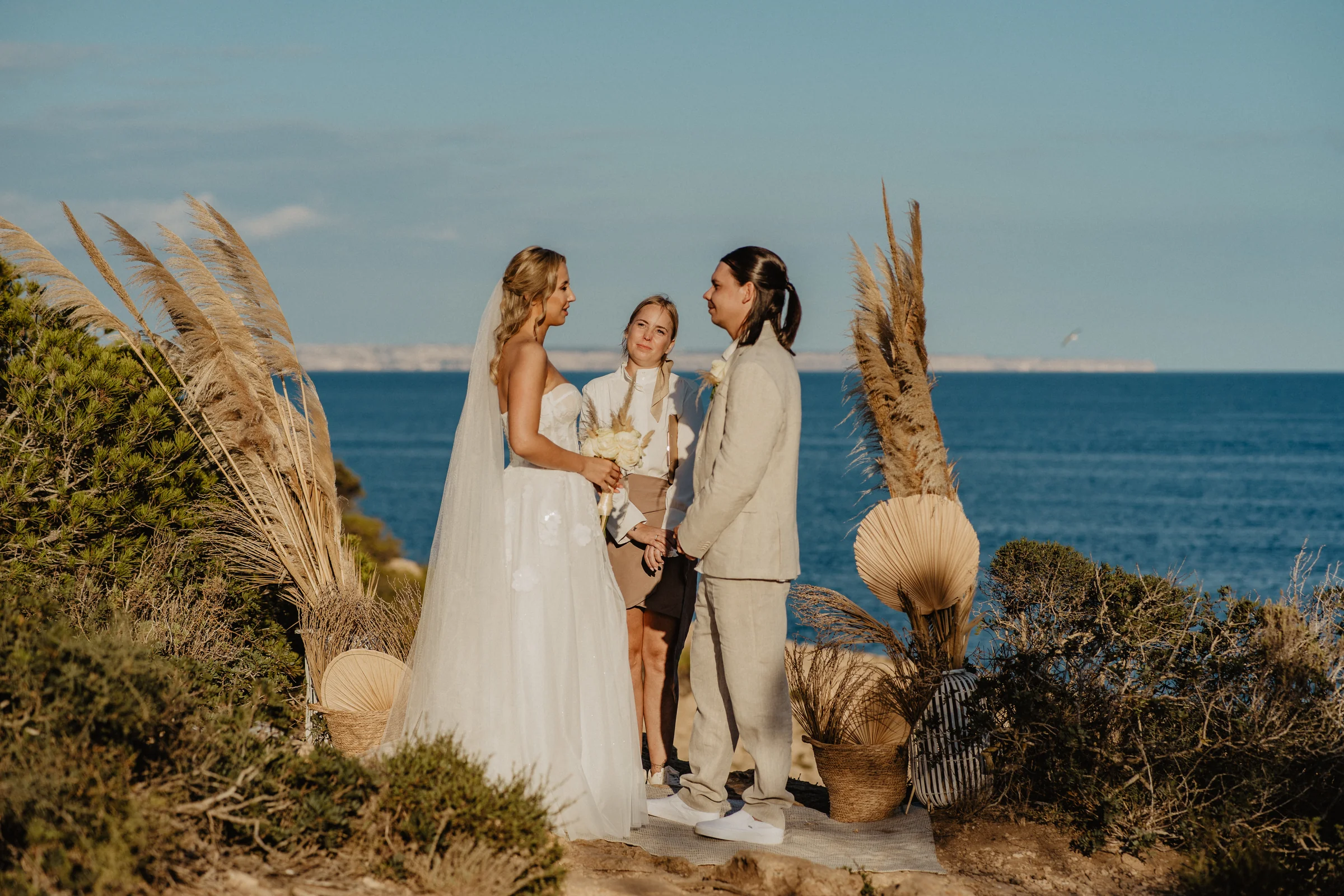
A symbolic ceremony carries no civil restrictions, so it can take place almost anywhere on the island. Beneath olive trees, on a clifftop above the Mediterranean, or in the garden of a private finca as the light softens in the early evening. Spanish law requires a legal civil ceremony to sit indoors, in an official setting. A symbolic ceremony, by contrast, can sit exactly where your story belongs. If you’d like to see how one of these ceremonies actually unfolds, watch this episode of The Mallorca Edit. It’s our video series on planning a wedding here.
There is also a quieter advantage, and it is central to how we work. Magdalena can guide your planning and also lead the symbolic ceremony herself. That means someone who already knows your story shapes the emotional centre of your day — not a stranger, at the end. Magdalena trained at a theatre school in Kraków. She brings that same sensibility to each ceremony: the pacing, the pauses, the moments that let emotion land. The result never feels generic. It feels like yours.
Want to understand the shape of the day in more detail? Read more about how a symbolic ceremony in Mallorca works.
The one exception: Catholic weddings

There is a meaningful exception worth knowing about.
If you are Catholic, you may be able to marry in a Catholic church in Mallorca and have the law recognise it. You would not need to meet the residency conditions that apply to a civil ceremony. A Catholic marriage carries its own requirements, plus a fair amount of preparation and paperwork you arrange ahead of time with the church. For the right couple, though, it offers both spiritual meaning and legal recognition in one ceremony.
It is not the simplest route, and it is not for everyone. But if faith is central to your day, it is worth exploring properly. We cover it in more depth in our guide to a Catholic wedding in Mallorca.
What you’ll want to prepare — without drowning in paperwork
Every couple’s exact requirements depend on your home state and your circumstances. They also depend on whether you marry legally at home or pursue a Catholic ceremony here. A checklist might be out of date by the time you read it. So instead, we’ll tell you the two things that genuinely matter.
First: sort the legal marriage at home early and calmly. Keep it entirely separate in your mind from the celebration. It is administrative, not emotional. Treat it that way and it stops feeling heavy.
Second: verify your specific requirements with an official source, not a blog — including this one. Your local registry office, and where relevant the Spanish consulate, are the right places to ask. Rules differ between US states and change over time. This is precisely the kind of detail you want confirmed, not assumed. (We are wedding planners and celebrants, not legal advisors — and we would always rather you had certainty than a guess.)
Everything else is what we are here to hold: the timing, the flow, and how the day comes together around your guests.
Planning it all from five thousand miles away

For American couples, the deepest worry is usually not the paperwork at all. It is the distance.
Can we really plan this from across an ocean? Will there be someone on the ground who actually knows the venues and suppliers? Someone who knows how the light falls at seven in the evening? What happens if something needs a decision while we are asleep and Mallorca is mid-afternoon?
This is the real value of working with someone who lives here. Not simply coordination, but local judgement. Someone who can walk a venue, question a supplier, and notice the detail that does not add up. Someone who will tell you honestly when a beautiful idea will not serve your guests. It removes the timezone anxiety and the fear of arriving somewhere you have only ever seen in photographs.
Want a fuller picture of how remote planning works in practice? Our complete guide to planning a destination wedding in Mallorca walks through the whole journey.
The Dybiec Wedding perspective: one person holding the whole picture
At Dybiec Wedding, we plan a limited number of weddings each year in Mallorca. Magdalena — wedding planner, celebrant and personal guide on the island — guides each one personally.
For a US couple, that combination matters more than it might first appear. The person helping you understand your legal options also shapes the flow of your day. That same person stands in front of you to lead your ceremony. Nothing passes between strangers. One person who already knows your story holds it, from the first conversation to the final vow.
That continuity is not a detail. For couples planning from abroad, that continuity often makes the difference. It separates a wedding that feels managed from one that feels truly theirs.
Frequently asked questions

Is a symbolic ceremony in Mallorca legally binding?
No — a symbolic ceremony is not legally binding on its own. That is by design. Couples complete the legal marriage in their home country — usually a short registry-office appointment. The symbolic ceremony in Mallorca is the full, personal celebration of that marriage. To your guests, it is indistinguishable from a legal ceremony.
Will our marriage be valid back home in the US if we have a symbolic ceremony?
Yes. Your legal marriage is the one you complete at home, under your own state’s law. The symbolic ceremony in Mallorca celebrates it; it does not replace it. Nothing stays uncertain when you return. Always confirm your specific state requirements with your local registry office.
Can we hold our ceremony on a beach, a finca or a clifftop?
Yes. A symbolic ceremony carries no civil-location restrictions, so it can take place almost anywhere on the island. Think olive trees, a private finca garden, or a spot overlooking the sea. Spanish law, by contrast, requires a legal civil ceremony to take place indoors, in an official setting.
Do we need to speak Spanish for our wedding in Mallorca?
No. Magdalena conducts ceremonies in English, and she works with international couples in several languages. Your guests will follow every word, and nothing about the day will feel lost in translation.
How far in advance should US couples start planning a Mallorca wedding?
As early as you comfortably can. The most sought-after venues and suppliers book far ahead, and planning from abroad benefits from a longer runway. Beginning with a conversation about direction, rather than a rush to secure dates, almost always leads to better decisions.
Before you go further
Are you a US couple weighing up whether Mallorca is right for you? The most useful next step is not another spreadsheet or venue shortlist. It is a conversation about what would genuinely work for you. Think your guests, your budget, and the kind of day you want to remember.
Our first conversation is never about selling a package. It is about helping you understand which direction makes sense. And it’s about showing you how the legal and emotional sides of your wedding can fit together. None of the stress you might be imagining needs to be part of it.
Begin a private conversation with Magdalena to understand what a Mallorca wedding could realistically look like for you.
