
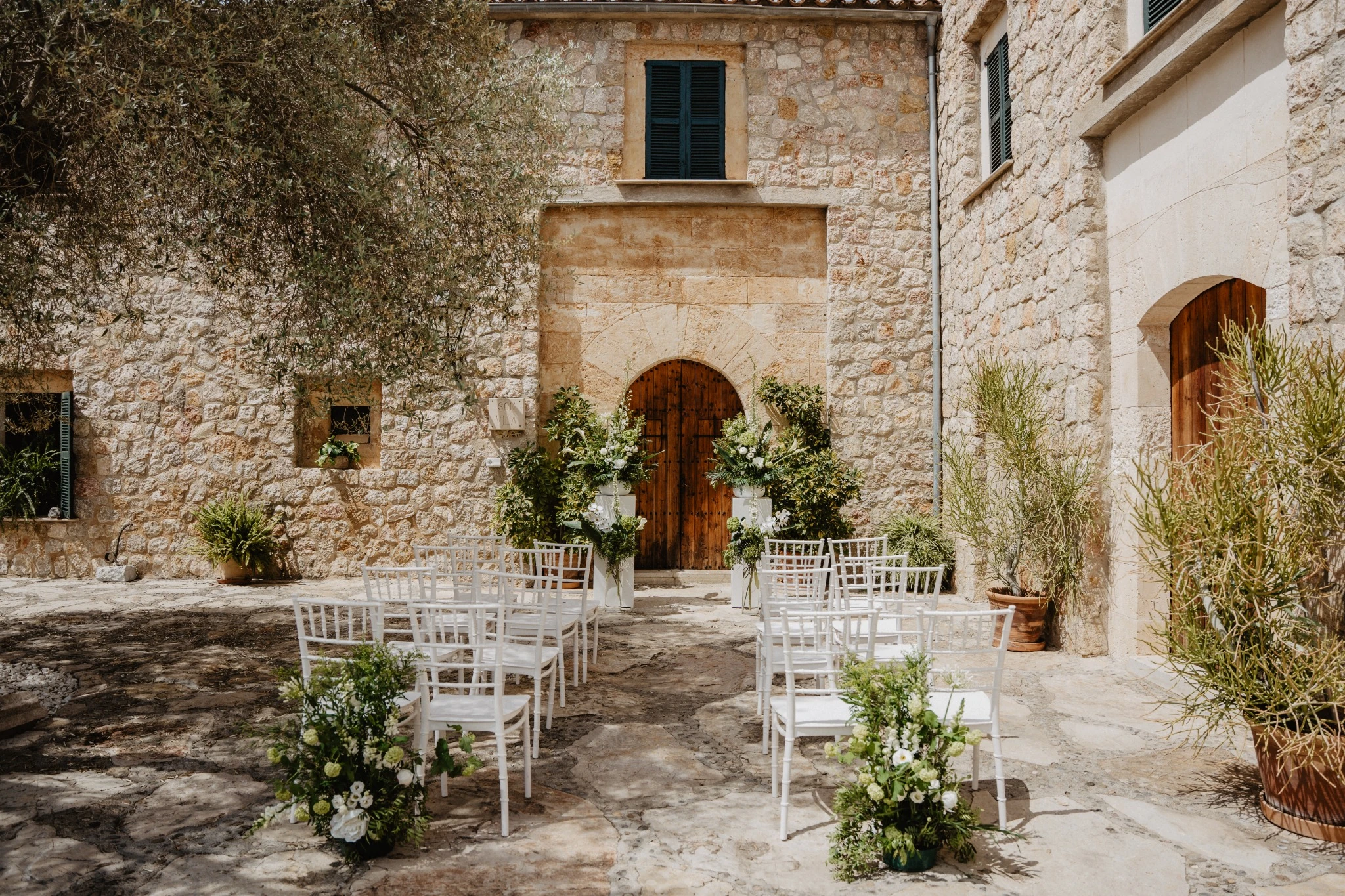
If you are considering a destination wedding in Mallorca, the most important thing to understand is not the venue, the flowers, or the catering. It is this: a wedding in Mallorca is only as good as the experience it creates — for you, and for every person who travels to be there. The island offers exceptional beauty, reliable weather and world-class venues. What transforms those elements into something genuinely unforgettable is the quality of planning, the depth of local knowledge, and the decision about who carries the responsibility — so that you do not have to.
Table of Contents
- The Moment Most Couples Don’t See Coming
- Why Couples Choose Mallorca for a Destination Wedding
- When Is the Best Time of Year for a Wedding in Mallorca?
- How Much Does a Destination Wedding in Mallorca Cost?
- What Type of Venues Are Available in Mallorca?
- How to Choose a Wedding Planner in Mallorca
- The Guest Experience: Why It Changes Everything
- Legal Considerations for Getting Married in Mallorca
- What Does a Mallorca Wedding Day Actually Look Like?
- The Difference Between a Wedding Planner and a Wedding Celebrant
- One Day or Three: How Format Shapes the Experience
- FAQ: Destination Wedding in Mallorca
The Moment Most Couples Don’t See Coming
You’ve spent months imagining this. The stone finca draped in evening light. The scent of the Mediterranean carried on warm air. The faces of the people you love most, gathered in one place.
And now you’re standing at the edge of your own reception, phone in hand, because someone needed a decision and there was no one else to ask. You look up. The music is playing. The candles are lit. Somewhere in that room, the evening is beginning without you.
You put the phone away and re-enter. But something has shifted. You are watching your wedding instead of living it.
This is the regret no one talks about in the planning phase. Not a supplier who didn’t deliver, not a flower arrangement that wasn’t quite right — but the quiet realisation, hours into a day you spent years imagining, that you became its coordinator rather than its subject.
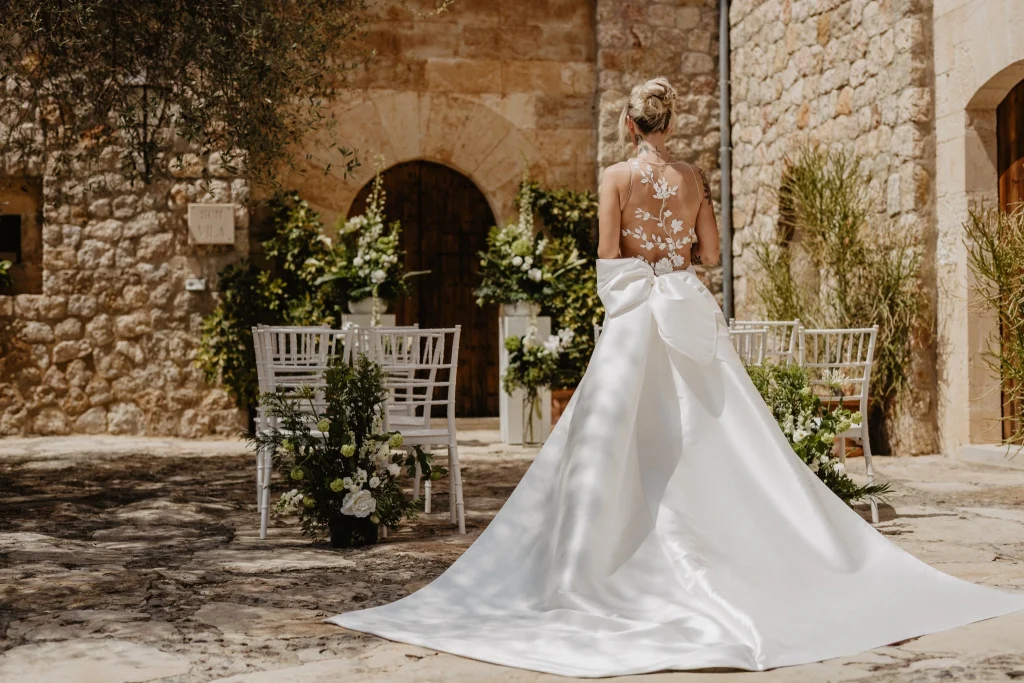
Planning a destination wedding in Mallorca means making hundreds of decisions in the months ahead. The most important one has nothing to do with venues or flowers. It is deciding, very early, who carries the weight of the day — so that on the day itself, you do not.
Why Couples Choose Mallorca for a Destination Wedding
Mallorca is consistently chosen by international couples — from the UK, USA, Australia and Scandinavia — as their preferred location for a European wedding. The reasons go beyond aesthetics, though the aesthetics are considerable.
The island offers something that very few Mediterranean destinations can combine: exceptional natural beauty, sophisticated hospitality infrastructure, logistical accessibility and a visual identity that is entirely its own. Warm limestone, ancient olive groves, terracotta, bougainvillea, the particular quality of light over the Tramuntana mountains at golden hour — Mallorca has a coherent aesthetic language that makes beautiful photography almost effortless and heavy decoration almost unnecessary.
Practically, Palma de Mallorca Airport receives direct flights from London, Manchester, Stockholm, Oslo, Copenhagen and multiple North American cities, which matters considerably when you are coordinating the arrival of guests from several countries.
The wedding season runs from April through October. Within that window, September and early October are consistently regarded as the finest months: the light is golden, the island is quieter than peak summer, and the temperature settles into something comfortable and unhurried — somewhere between 24 and 28 degrees Celsius, with long warm evenings that invite a celebration to slow down and breathe.
When Is the Best Time of Year for a Wedding in Mallorca?
September and October are the months most frequently chosen by couples working with Dybiec Wedding. If you want the best combination of extraordinary light, comfortable temperature and a quieter island, these months consistently deliver.
| Month | Temperature | Atmosphere | Notes |
|---|---|---|---|
| April | 18–22°C | Quiet, lush | Beautiful greenery; occasional rain |
| May | 22–26°C | Moderate | Excellent balance; popular choice |
| June | 26–30°C | Busy | Long evenings; beautiful natural light |
| July | 30–34°C | Peak season | Best for late evening ceremonies |
| August | 30–34°C | Busiest month | Book 18+ months in advance |
| September | 26–30°C | Quieter | Widely considered the finest wedding month |
| October | 22–26°C | Quiet, warm | Golden light; relaxed atmosphere |
If you are planning for 2027 or beyond, the most desirable venues — particularly the sought-after fincas in the Tramuntana foothills and the clifftop estates of the western coast — typically confirm bookings 12 to 18 months ahead. In some cases, two years. The earlier you begin, the more choices remain open to you.
How Much Does a Destination Wedding in Mallorca Cost?
You can expect a destination wedding in Mallorca to start from approximately €35,000 for an intimate celebration of 20 to 40 guests at a premium level of quality. For larger celebrations or those with higher specification, budgets between €60,000 and €100,000 are common among international couples. Some celebrations exceed this considerably.
The most frequent source of confusion — and the one most worth addressing early — is the difference between a venue’s minimum spend and the true all-in cost of the wedding. A venue may quote a catering minimum of €15,000. The actual total, including all suppliers, your wedding planner, the celebrant, flowers, music, photography, transportation and lighting, will typically be two to three times higher.
Understanding what the budget actually needs to cover allows you to make better decisions earlier — and avoids the very common experience of having a beautiful vision gradually compressed by costs that were never properly mapped at the start.
The areas couples most consistently underestimate:
- Guest accommodation coordination (not a venue cost, but a significant guest experience factor)
- Airport transfers
- Contingency fund — typically 8 to 12 per cent of total budget
- Tipping for venue and catering staff
- Pre-wedding guest communication and information logistics
You can model your own investment level using the Dybiec Wedding Cost Calculator, which is designed specifically for international couples working through what a Mallorca wedding realistically involves.
What Type of Venues Are Available in Mallorca?
Mallorca’s venue landscape is one of its greatest strengths as a destination. The island offers a genuine range of settings — not just aesthetically, but in terms of what each venue makes possible for the experience of the day.
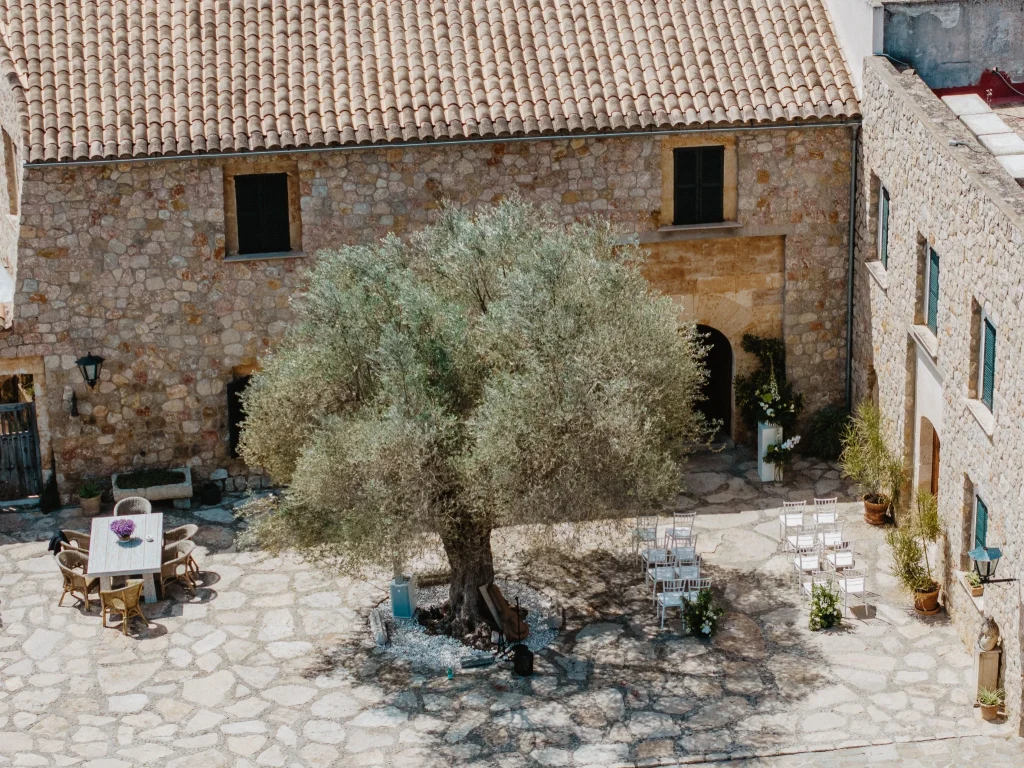
Fincas and rural estates remain the most iconic category. These are stone farmhouses — some dating back several centuries — set within olive groves, vineyards or almond orchards. They offer outdoor ceremony spaces, covered terraces for dinner, and in many cases private accommodation for the couple and immediate family. They suit intimate to mid-size celebrations (20 to 120 guests) and require very little artificial decoration; the environment itself creates the atmosphere.
Clifftop and sea view venues along the western coast — around Andratx, Port de Sóller and the Tramuntana coastline — offer panoramic Mediterranean views that are among the most photographed settings on the island. These tend to be operationally more complex, but the visual results can be extraordinary.
Historic properties and manor houses offer architectural grandeur within a private estate setting. These suit couples seeking a more formal, editorial aesthetic — a different quality of setting from the warmth of a rural finca.
Private villas and boutique hotel gardens work well for smaller celebrations and elopements where privacy and flexibility are the priority.
When Magdalena works with a couple on venue selection, it is never approached in isolation. The venue shapes the entire flow of the day — how guests move, how light changes across the afternoon and evening, how the atmosphere evolves from the ceremony through to dinner and into the night. The right venue is not simply the most beautiful one. It is the one that makes the experience you want to create feel possible and natural.
Not the Flowers. Not the Venue. This.
If you are planning a destination wedding from abroad, this is the decision that determines everything else. Not the venue. Not the flowers. The person who takes responsibility for translating your vision into an experience that is exactly as you imagined it — and who ensures that when something needs handling on the day, it reaches them, not you.
A wedding planner in Mallorca should demonstrate genuine local expertise: knowledge of venues that are not simply visible on international directories, established relationships with trusted suppliers, fluency in the legal and administrative landscape specific to Spain, and a real understanding of what changes when you are coordinating an event involving guests from multiple countries.
Beyond technical competence, the best wedding planners are creative and emotional partners. They listen carefully. They translate a couple’s instinct for what they want into a coherent design language. And they protect your energy across a process that typically spans twelve months or more.
Questions worth asking before you commit:
- How many weddings do you take on in a single year?
- How do you ensure that decisions don’t reach us on the wedding day?
- Can you describe how a recent wedding unfolded, from first conversation to farewell?
- What is your approach when something unexpected happens on the day?
The last question is the most revealing one. A planner who can answer it clearly — describing the briefing process, the contingency planning, the supplier communication structure — is a planner who has genuinely thought about responsibility transfer, not simply event logistics.
Dybiec Wedding works with a carefully selected number of couples each year. Magdalena — wedding planner, celebrant and personal guide in Mallorca — leads every project personally, from initial consultation to the final farewell. There are no handovers, no junior coordinators managing the day on her behalf. The person you speak to at the beginning is the person who stands beside you throughout.
The Dybiec Wedding blog offers an honest, detailed library of guidance on every stage of the planning process — written for couples who want to understand what premium wedding planning in Mallorca actually involves before they begin making commitments.
The Guest Experience: Why It Changes Everything
You’ve probably spent considerable time thinking about what your wedding day will look like. The venue, the ceremony, the table design, the flowers. These things matter. But there is something that matters more — and it is one of the things most easily missed in the early planning phase.
Your guests are travelling. Some from the UK, some from further. They are investing their time, their money, their annual leave, their childcare arrangements. For international guests, the cost of attending your wedding is not trivial. And with that investment comes a real and understandable expectation — not of perfection, but of being genuinely looked after.
The weddings that guests talk about years later are almost never the most decorated ones. They are the ones where every moment felt considered. Transfers arrived on time. Guests moved naturally from one moment to the next, without looking for signs or asking questions. The ceremony flowed into cocktails, cocktails into dinner — and the whole day unfolded with a quiet inevitability, as if it could only ever have been this way.

This quality — invisible to guests when it is present, immediately noticeable when it is absent — is the defining characteristic of a well-planned wedding. It does not happen by chance. It is designed, in detail, long before the day.
If you want to understand how this kind of guest experience is built from the ground up, the Mallorca Edit series on YouTube explores the architecture of destination wedding planning in genuine depth — from transport logistics to the emotional flow of a celebration.
Legal Considerations for Getting Married in Mallorca
Most international couples marrying in Mallorca choose a symbolic ceremony. This is worth understanding clearly before you begin planning.
A symbolic ceremony has no legal standing in Spain. It allows complete creative freedom: freedom of location, freedom of content, freedom of language, freedom of structure. The ceremony is entirely personalised — written around the couple’s story, their values, the people in the room. Couples who choose a symbolic ceremony typically register their marriage legally in their home country either before or after the Mallorca celebration.
A legally binding civil ceremony in Spain follows the requirements of Spanish law. The administrative process is specific and varies depending on the nationality of the couple. Documents typically required include birth certificates, proof of single status and certified translations. The process can take several months and requires coordination with local civil registries. For UK couples in particular, the administrative pathway post-Brexit has added some complexity.
The significant majority of international couples working with Dybiec Wedding choose a symbolic ceremony. The reasons are practical (administrative simplicity) and personal (the complete freedom to create a ceremony that genuinely reflects who they are, in the language they want, in the setting they have chosen).
Magdalena is both a wedding planner and a trained celebrant. This dual role creates something relatively uncommon: the person who has guided you through twelve months of planning is also the person who writes and delivers the ceremony itself. The words spoken at the emotional centre of your wedding day come from someone who genuinely knows your story.
For a full guide to the legal landscape for international couples marrying in Mallorca, the Mallorca Wedding Guide covers this in practical detail.
What Does a Mallorca Wedding Day Actually Look Like?
The rhythm of a Mallorca wedding is shaped by the Mediterranean climate. The heat of midday means outdoor ceremonies are almost always held in late afternoon — typically from 5pm onwards — as the temperature softens and the extraordinary golden light begins to arrive.
A representative timeline for a late summer or early autumn wedding:
| Time | Moment |
|---|---|
| 14:00–16:00 | Couple preparation; guests arriving and settling at the venue |
| 17:00–17:30 | Ceremony — outdoor, in natural light |
| 17:30–19:30 | Cocktail hour: drinks, canapés, informal music, photography |
| 19:30 | Guests seated for dinner |
| 19:45–23:30 | Wedding dinner: courses, speeches, first dance, dancing |
| 23:30 onwards | Evening continues; music transitions to party |
| 01:00–02:00 | Carriages; guests depart |
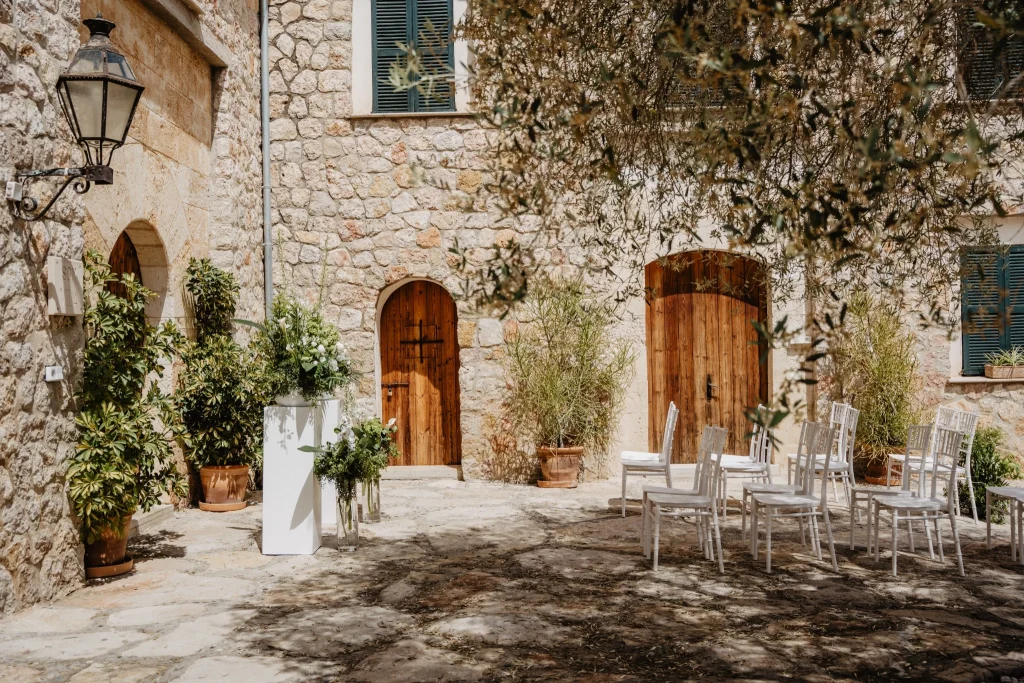
This is a guide, not a formula. What matters far more than the timeline is the quality of each transition — the invisible architecture that moves the day from one moment to the next without anyone feeling managed, hurried or uncertain.
The best Mallorca wedding days feel unhurried not because they are loosely planned, but because they are very precisely planned by someone who has done this many times before. Every buffer zone is intentional. Every transition has been designed so that it feels natural. The team carries the operational timeline; you inhabit the emotional one.
The Difference Between a Wedding Planner and a Wedding Celebrant
Many couples arriving at the beginning of the planning process are unclear about this distinction — and whether they need both.
A wedding planner manages the full scope of the planning process from start to finish: venue selection, supplier relationships, budget oversight, guest logistics, design coordination, timeline architecture and on-the-day management.
A wedding celebrant designs and leads the ceremony. A skilled celebrant writes a ceremony from scratch — built around the couple’s relationship, their values, their language, the people present. The ceremony is performed in the moment and creates the emotional heart of the wedding day.
These are genuinely different skills. In most destination weddings, they are filled by two different people. When Magdalena works with a couple at Dybiec Wedding, she offers both — which creates a quality of continuity that is rare. The person who has accompanied you through the entire planning journey is also the person who stands before your guests and speaks the most important words of the day.
One Day or Three: How Format Shapes the Experience
A well-designed single-day wedding in Mallorca can be exceptional. This is the standard format — and at a boutique luxury level, it can be everything a couple hopes for.
For some couples, however, there is a deeper option worth knowing about.
A three-day wedding experience extends the celebration across three days: a welcome day, a ceremony and celebration, and a farewell day. This format is not a default, and it is not the right choice for every couple. It depends on budget, guest count, logistics and what you genuinely want from the experience.
But for couples who have attended enough single-day weddings to notice how quickly they pass — how a day spent building towards a moment can leave almost no memory of the moment itself — the three-day format offers something that a single day structurally cannot: time.
Welcome Day — Guests arrive, settle into Mallorca, and reconnect without a timetable or pressure. There is no schedule to meet, no ceremony to prepare for. Simply the beginning of an experience together.
Wedding Day — Because guests have already arrived, already reconnected, already begun to relax into the island, the wedding day itself carries a different quality. The atmosphere is warmer. The conversations are easier. The ceremony feels more intimate because the room is already full of people who have spent time together.
Farewell Day — Rather than a morning airport dash, the final day offers a gentle close: a shared brunch, final conversations, a proper goodbye to a place and an experience that has meant something. Couples who have experienced this format often describe the farewell day as unexpectedly moving.
This is one interpretation of Your Mallorca Wedding Story — a complete three-day narrative with a beginning, a middle and an ending that is unhurried enough to be felt.
FAQ Destination Wedding in Mallorca
How far in advance should I start planning a destination wedding in Mallorca? For most international couples, 12 to 18 months is a realistic minimum. The decisions that matter most — your overall guest count, your format, your budget architecture — need to be made before venue selection begins. For the most sought-after venues inThe Decision That Shapes Everything Else September or October, some couples book two years ahead.
Do I need a wedding planner for a destination wedding in Mallorca? Planning a destination wedding from abroad involves coordinating multiple suppliers, venues, legal processes and international guest logistics simultaneously. An experienced local wedding planner brings knowledge and relationships that cannot be replicated through research alone. More importantly, the right planner ensures that operational decisions don’t reach you on the day — which is arguably the most valuable thing professional planning provides.
What is a symbolic ceremony, and is it right for us? A symbolic ceremony has no legal standing but allows complete creative freedom in terms of location, content, language and structure. It is the most common format for international couples marrying in Mallorca, and it is the format that allows the most genuinely personal ceremony experience. Couples typically register their marriage legally at home before or after the celebration.
What is the true all-in cost of a destination wedding in Mallorca? An intimate celebration of 20 to 40 guests at a premium level typically starts from approximately €35,000. Larger celebrations with higher specification commonly range from €60,000 to €100,000 and above. The Mallorca Wedding Cost Calculator is designed to help you model a realistic total for your specific plans.
How do I ensure my guests feel genuinely looked after? Guest experience in a destination wedding begins before the wedding day: clear travel information, accommodation guidance, airport transfers if appropriate, and pre-arrival communication that makes guests feel expected rather than organised. On the day itself, the quality of transitions — how guests move from one moment to the next — defines the experience more than any single decorative detail.
What is the best month for a wedding in Mallorca? September and early October are widely considered the finest months. The light is extraordinary, the temperature is comfortable (typically 24–28°C), the island is quieter than peak summer, and the landscape has a warm, late-season quality that produces exceptional photography.
What happens if something unexpected occurs on the day? A well-planned wedding in Mallorca includes detailed contingency structures: weather alternatives, supplier redundancy plans, clearly defined lines of communication, and a planner who has already anticipated the variables that typically arise. Experienced planners do not rely on optimism. They rely on structure built months in advance.
How do I begin? The most effective first step is a private conversation with an experienced Mallorca wedding planner who can help you understand what is realistic for your timeline, budget and vision — and whether Dybiec Wedding is the right fit for what you are hoping to create.
Begin Your Mallorca Wedding Story
You have imagined this. The light. The people. The feeling of a day that is entirely, unhurriedly yours.
What you are looking for is not someone to organise a wedding. You are looking for someone who can carry the weight of the whole thing — so that you are free to be completely present for it.
That is what Magdalena offers. A curated wedding experience in Mallorca, personally guided from the first conversation to the final farewell — designed around your story, not a template.
If you are ready to begin a private conversation, Dybiec Wedding is here.

One Response