

Most couples looking for a Mallorca wedding planner judge their work by what they can see: the venue, the table, the flowers and the light falling across the terrace at dinner. But the most important work a local wedding planner in Mallorca does sits somewhere else entirely. The calm you feel on your wedding day is not a mood, a styling choice or a decoration. It is the visible result of dozens of decisions made — and dozens of risks quietly removed — long before your first guest arrives. That invisible work is what you are really paying a local planner for. Everything beautiful you can see depends on it.
I want to be honest about what that work is, because almost no one describes it. It is easy to promise you a “stress-free” or “seamless” day — every wedding planner on this island says it, and I understand why. But a promise is not a mechanism. So instead of telling you the day will feel calm, I would rather show you where that calm actually comes from.
Contents
- The part of the wedding no one photographs
- What twelve years on the island actually changes
- Why most of my work happens long before your wedding day
- So what is the real luxury?
- Questions couples ask me before they commit
- A quieter next step
The part of the wedding no one photographs

Here is something I have learned after years of doing this: the biggest threat to a wedding is almost never the thing couples worry about in advance.
It is not the weather. It is not the cake. It is stress — the slow, invisible kind that pulls a couple out of their own day. I have watched a bride spend her ceremony hour glancing at her phone because a supplier had gone quiet. I have seen a groom miss the toast his brother had rehearsed for weeks because he was outside, in the car park, trying to redirect a delivery driver who had the wrong gate. Nothing “went wrong” in either case. The photos were beautiful. But the couple was not fully there, and you cannot photograph the difference. You can only feel its absence, later, when you realise you were managing your wedding instead of living it.
That is the loss I work hardest to prevent. Not a logistical failure — a presence failure. A couple who are physically at their wedding but mentally still holding the list.
This is not a checklist tip. It is the reason I do the job the way I do. Everything that follows exists to keep that phone in your pocket and that groom in the room.
What twelve years on the island actually changes

I moved to Mallorca in 2014. I did not start planning weddings until 2021. That gap matters more than any credential I could put on a page.
For seven years before this was my profession, Mallorca was simply where I lived. I learned which roads flood after an autumn storm and which stay clear. I learned that a supplier’s warmth in a first email tells you very little, and that the ones worth trusting are often the ones slow to reply because they are actually working. I learned the rhythm of the island in August, when the whole place slows down and a “quick confirmation” from a vendor can take a week that a couple in London or New York has not planned for.
None of that is on a website. It is the kind of knowledge you can only get by being somewhere long enough to stop being a visitor.

When a couple sends me a venue they have found online — and it usually is stunning — I am not looking at the photograph. I am reading it the way a local reads it. Where do a hundred guests actually park? Is there a sound limit that ends the music at midnight, no exceptions, regardless of what the brochure implied? Is the “twenty minutes from the airport” true in June traffic, or is that a wet-season number? Which caterers are physically allowed to work in that kitchen, and which are not? A beautiful venue with the wrong answers to those questions becomes a stressful wedding. The picture never tells you which one you are looking at. Living here does.
Why most of my work happens long before your wedding day
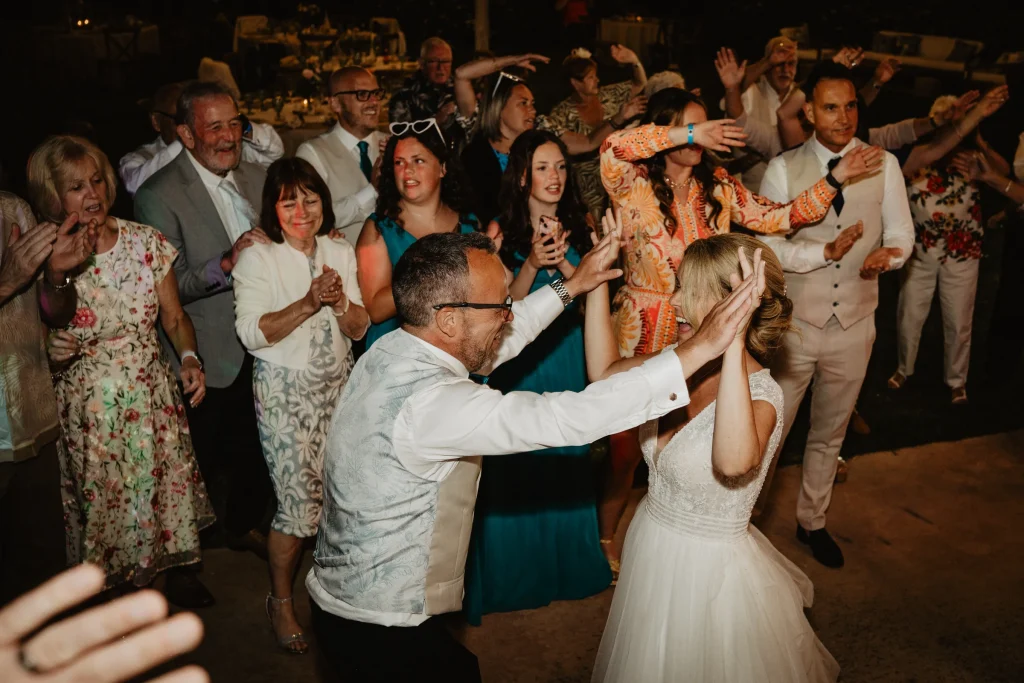
If you watched me work, the wedding day itself would probably be the least interesting part. By then, most of what matters is already decided.
The real work is earlier, and it is quiet. It looks like sitting with your guest list and mapping how a hundred people will actually move through a single day. It means knowing where they sleep, how they get from the hotel to the ceremony, what happens in the ninety-minute gap most couples forget to plan for, and how elderly relatives manage a gravel path in the heat. It looks like walking a venue months ahead and noticing the one thing that will cause friction, then quietly designing it out before it ever reaches you. It looks like knowing which three decisions genuinely shape everything else — the first decisions couples so often underestimate. Then it means making sure we get those right before we spend energy on the details that feel urgent but aren’t.
Most of my job is not solving problems on the day. It is removing the conditions that create them, months in advance, so that by the time you arrive there is almost nothing left to go wrong.
There is one more advantage to the way we work, and it is structural rather than sentimental. Dybiec Wedding is family-led — planning and ceremony, flowers, music and logistics all sit under one plan from the beginning, rather than four separate suppliers each working to their own. That is not a warm story about a family business. It is fewer gaps between the people responsible for your day, which means fewer places for the invisible stress to hide. And because I guide the planning and can also lead your ceremony, the emotional centre of the day stays connected to everything around it, rather than being handed to a stranger at the last moment.
So what is the real luxury?
For a long time I would have said the real luxury of a Mallorca wedding is the setting — the sea, the olive trees, the light. It is not. Those are the easy part; the island provides them for free.
The real luxury is subtler, and it is this: on your wedding day, you get to stop holding it. Not because no one is holding it — because someone else is. The details do not vanish. They are simply carried by a person on the ground who knows this island, has anticipated the friction, and has already dealt with it while you were getting ready. That is the difference between a wedding you organise and a wedding you get to actually be present at.
That is what I am really offering. Not a longer wedding, not a grander one. A more present one.
Questions couples ask me before they commit
Do I really need a local wedding planner in Mallorca, or can I coordinate it myself from abroad? You can coordinate it yourself, and some couples do. The question is what your own wedding day is worth to you as an experience. Planning from abroad means you cannot see the friction points a local sees, and it means you become the person the supplier calls at the wrong moment. A local planner’s real value is not the booking — it is absorbing the problems that would otherwise land on you on the day.
What does a Mallorca wedding planner actually do that I can’t do online? The visible things — venue, suppliers, timeline — you can partly arrange yourself. The invisible things are harder: reading a venue for hidden logistical limits, knowing which suppliers are genuinely reliable versus merely charming, and anticipating the specific ways a hundred travelling guests create pressure that a photograph never shows. That local reading is the part that cannot be replicated from a laptop.
Is planning a wedding in Mallorca from the US or UK complicated? It is manageable, but the distance creates specific anxieties — time zones, no one on the ground, uncertainty about whether guests will cope with the travel. Most of my work for international couples is simply being the local presence that removes those anxieties: the person who is here, so you don’t have to worry about not being.
How far in advance should we start? Earlier than most couples expect. The best venues and suppliers on the island book far ahead in peak season, and the decisions that shape everything else benefit from being made calmly rather than under time pressure. The lead time is not about doing more — it is about doing the important things without rushing.
Does a bigger, multi-day wedding feel more luxurious than a single day? No — and I would gently push back on the assumption. The wedding day is the emotional foundation of every celebration we create, whether it stands alone or expands into a longer rhythm. A two- or three-day wedding is a different shape of experience, not a superior one. The aspiration is never a longer wedding. It is a more meaningful one.
A quieter next step
If you are at the beginning of this, you do not need a quote or a package yet. You need to understand what would genuinely work for your guests, your budget and the feeling you want the day to have.
Before you commit to a venue you have found online, begin a private conversation with me about direction — not dates and prices, but what kind of Mallorca wedding would actually let you be present at your own. That conversation is usually where the calm really starts.
Magdalena Dybiec is a wedding planner, celebrant and personal guide based in Mallorca. She has lived on the island since 2014 and has planned and led destination weddings for international couples since 2021.
