

A venue coordinator works for the venue. A wedding planner works for you. In Mallorca, that distinction matters far more than it does at home — because the gap between what a venue coordinator handles and what an international couple actually needs is wider here than almost anywhere else. A coordinator makes sure the venue runs smoothly on the day. A planner holds everything else: your guests arriving from three countries, transport between a hillside finca and your hotel, suppliers who speak Spanish while you speak English, and the hundred decisions that begin long before anyone unlocks the venue gate.
Most couples planning a Mallorca wedding meet a venue coordinator first — often the friendly person who gives the initial tour — and quietly wonder whether they need to pay for a planner on top. It is a fair question. This guide answers it honestly, from the ground here in Mallorca.
Contents
- The short answer
- What a venue coordinator actually does
- What a wedding planner actually does
- Why the difference is bigger for a destination wedding
- The five gaps a venue coordinator cannot close in Mallorca
- “But the venue said we don’t need a planner”
- The Dybiec Wedding perspective: guidance before decisions become expensive
- How to decide what you need
- FAQ
The short answer
A venue coordinator is employed by the venue and is responsible for the venue: its staff, its spaces, its rules, its operations on the day. A wedding planner is hired by you and is responsible for your entire wedding — every supplier, the budget, the guest logistics, the timeline, and the parts of the day that happen nowhere near the venue.
They are not competing roles. At their best they work side by side. But they are not interchangeable, and assuming one covers the other is the single most common — and most expensive — misunderstanding couples carry into a Mallorca wedding.
What a venue coordinator actually does
A venue coordinator’s world begins and ends at the property. Their job is to make sure the space is ready, the venue’s own staff know their roles, and the rules of the estate are respected.
That typically means overseeing tables, chairs, and linens the venue provides; managing in-house catering or bar staff where the venue supplies them; confirming load-in and set-up times; making sure the lights work, the space is clean, and the contract you signed with the venue is honoured. On the day, they are the point of contact for anything to do with the building and grounds.
This is genuinely valuable work. A good venue coordinator knows their property intimately. But notice the boundary: everything they do is defined by the venue’s interests, not yours. When a decision falls outside the property line — or outside the venue’s contract — it is no longer theirs to make.
One detail couples rarely anticipate: the coordinator you meet on your tour is often not the person you have on your wedding day. Venue teams change. It is not unusual to deal with one person during booking, another mid-planning, and a third by the time you marry. Their loyalty, quite reasonably, is to the venue — not to the continuity of your particular wedding.
What a wedding planner actually does
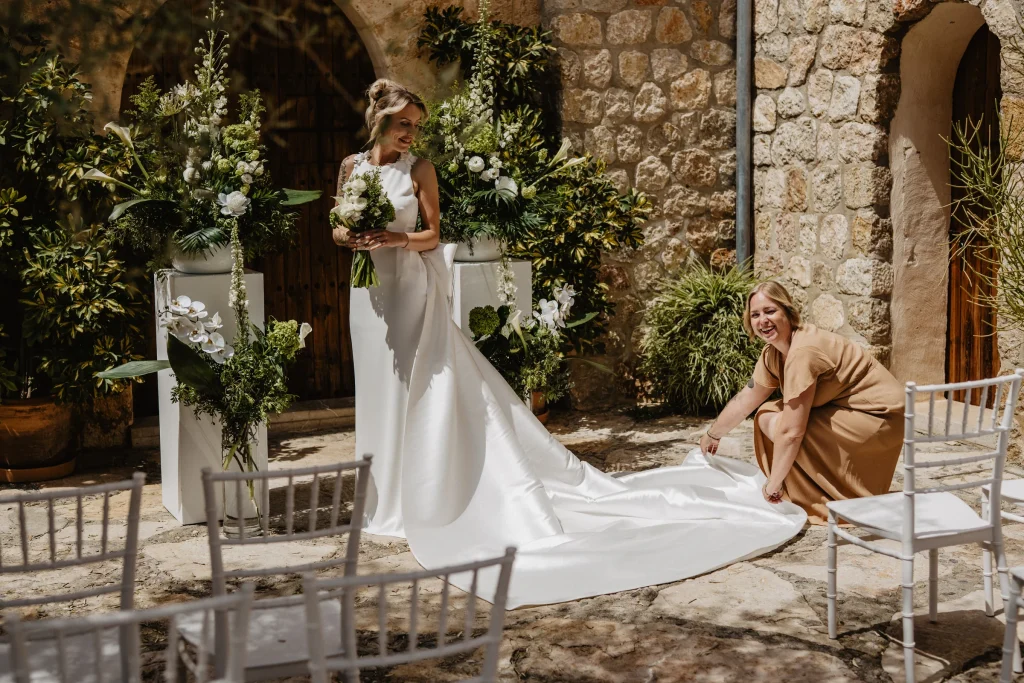
A wedding planner is hired by you and works only in your interest. Their responsibility is the whole wedding, wherever it happens to take place.
That means shaping the budget and tracking it across every supplier; sourcing and vetting florists, photographers, musicians, celebrants, and caterers; building the master timeline that covers the day from the moment you wake to the last song; coordinating everything that happens off the venue — the welcome dinner, guest transport, the getting-ready morning, a ceremony in a different location; and being the single person who knows how all of it fits together.
Crucially, a planner is your advocate. When something goes wrong — a supplier is late, the weather turns, a guest’s flight is cancelled — the planner absorbs it so you never have to. Their timeline does not stop at the venue’s start and end times. It holds the entire arc of your celebration.
For a destination wedding, that advocacy starts many months before anyone sees the venue in person.
Why the difference is bigger for a destination wedding
Here is what almost every article on this topic misses: they assume you and your venue are in the same country, speaking the same language, able to drive over on a Saturday to sort things out. A Mallorca wedding for a couple from the UK or the US works nothing like that.
When you are planning from two thousand miles away, the venue coordinator’s boundary becomes a real and practical problem. Everything that lives between suppliers, between venue and hotel, between your language and the island’s — none of it belongs to the coordinator. And on a destination wedding, that “between” space is where most of the work actually is.
A venue coordinator in Mallorca is not going to build your guests’ airport-to-hotel transport plan. They will not translate a catering contract written in Spanish. They will not tell you whether your dream finca sits thirty minutes from the nearest accommodation your older guests can realistically manage. Furthermore, they will not guide you through the paperwork for a symbolic ceremony. These things are not failures on their part — they are simply outside the role. But someone has to hold them. At a destination wedding that someone is either a planner, or it is you, from your kitchen table, at a distance, in a second language.
The five gaps a venue coordinator cannot close in Mallorca
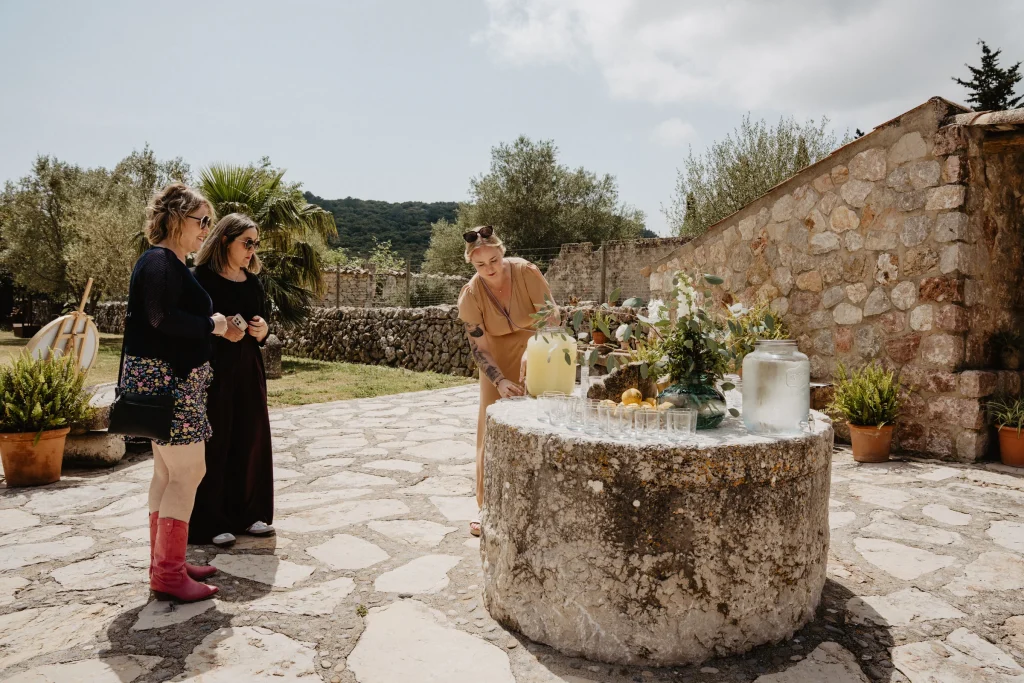
1. Guest logistics from abroad. Flights landing across a whole weekend, transfers, room blocks, who can manage stairs, who needs an early night before the ceremony. The venue’s remit ends at its own gate.
2. The language gap with local suppliers. Many excellent Mallorca suppliers work primarily in Spanish or Catalan. A planner on the ground reads the contracts, catches what is unsaid, and makes sure nothing is lost between your vision and its execution.
3. Everything off-site. A welcome gathering the night before, a ceremony somewhere other than the reception venue, a farewell brunch — a coordinator has no reason and no mandate to touch any of it.
4. Budget across the entire wedding. A coordinator can quote you the venue’s costs. Only a planner sees the full picture — where money is quietly leaking, where it is well spent, and whether your overall budget is realistic for what you are imagining. (If that is your open question, our guide to what a Mallorca wedding really costs is a more honest starting point than any venue quote.)
5. Someone who is genuinely yours. With venue-team turnover, the coordinator may change three times before your date. A planner is the one constant who has known your wedding from the first conversation.
“But the venue said we don’t need a planner”
You will hear this. Often the biggest selling point a venue offers is “our coordinator is included — you won’t need to pay for a planner.”
It is worth understanding why they say it, and why it does not quite hold. The offer is made in good faith — many venue coordinators are superb at their jobs. But “included coordinator” and “wedding planner” describe different work. Believing they are the same is how couples arrive at their wedding week underprepared, suddenly realising that no one has built a timeline, confirmed the florist’s arrival, or arranged how sixty guests get up the hill to the ceremony.
When a venue tells you a planner is unnecessary, the useful response is a question: Will this person manage my other suppliers? Build my full-day timeline? Handle everything happening away from your property? Be here the whole day, working for me? If the honest answer is no — and for a venue coordinator it usually is — then you have your answer about what is still missing.
The Dybiec Wedding perspective: guidance before decisions become expensive

At Dybiec Wedding, the reason we exist sits precisely in the gap this article describes. The most costly mistakes in a Mallorca wedding are seldomly made on the wedding day. They are made months earlier — a venue chosen before anyone checked where guests would sleep, a budget shaped around a beautiful setting that then can’t accommodate the flow of the day.
There is a further layer many couples find reassuring. Because Magdalena guides the planning and can lead your symbolic ceremony herself, the emotional centre of your day is not handed to a stranger at the last minute. The same person who has come to understand your story over months of planning is the one who stands with you as you marry. Continuity, rather than a series of separate hands.
The family-led structure behind Dybiec Wedding — planning, ceremony, flowers, music, and logistics kept connected from the beginning — exists for the same reason. It is not sentiment. It is fewer gaps for something to fall through.
You can read more about Magdalena’s approach and background here.
How to decide what you need
Ask yourself three plain questions. Are most of your guests travelling from abroad? Is your wedding spread across more than one location or more than one day? Do you feel confident personally managing Spanish-speaking suppliers, a full-day timeline and guest transport, from home, in the months before the wedding?
If the answers point toward complexity and distance — as they do for almost every international Mallorca wedding — a venue coordinator alone will leave real gaps. Not because coordinators fall short, but because the role was never designed to close them.
The clearest first step is not to book anything, but to understand what your particular wedding will actually require. Before committing to a venue, begin a private conversation with Magdalena about what kind of support your guests, budget, and vision genuinely call for — or, if you would rather read first, download The Mallorca Wedding Guide to understand the decisions couples most often underestimate.
FAQ
Do I need a wedding planner if my Mallorca venue includes a coordinator? Usually yes, for a destination wedding. The venue coordinator manages the venue; they do not manage your other suppliers, your guest logistics, your budget across the whole wedding, or anything happening away from the property. Those remain your responsibility unless you have a planner.
What is the difference between a wedding planner and a venue coordinator? A venue coordinator is employed by the venue and responsible for the venue’s operations. A wedding planner is hired by you and responsible for your entire wedding — every supplier, the timeline, the budget and the guest experience, wherever it takes place.
Is a venue coordinator free? It is frequently described as “included” in the venue package. But it covers only venue-related duties. It is not a substitute for the full-service planning most international couples need, so treating it as a free planner tends to create hidden gaps rather than real savings.
Can one person be both in Mallorca? Rarely at the same wedding because their loyalties differ — the coordinator serves the venue, the planner serves you. What you can have is a planner who works alongside the venue’s coordinator, which is the smoothest arrangement of all.
Why does the planner-versus-coordinator distinction matter more for a destination wedding? Because so much of a destination wedding happens outside the venue’s boundary: international guest travel, the language gap with local suppliers, multi-location or multi-day celebrations, and planning conducted from another country. A venue coordinator’s role stops at the property line; a destination wedding’s needs do not.
When should we decide? Before you book your venue, not after. The venue you choose affects your guest logistics, budget, and the flow of the day — which is undoubtedly the territory a planner helps you assess. Deciding on planning support early is what keeps the venue decision from becoming an expensive one.
